The 2-Minute Check That Tells You If Your 6-Year-Old Is Actually Reading (or Just Guessing)
Is your six-year-old flying through their books, but completely freezing when they encounter a brand new word? It is a stressful moment at the kitchen table, but it is a very common hurdle! When this happens, it usually means your child might be relying on visual memory instead of genuine decoding.
Many children learn to compensate for weak decoding skills by analyzing the whole visual shape of a word or guessing from picture clues. This visual memorization might look like fluent reading, but guessing actively hinders their mind from mapping letters to sounds permanently. We need a way to figure out exactly what is happening cognitively, and we don’t need a formal, high-pressure testing environment to do it.
The Secret Assessment Tool: Nonsense Words
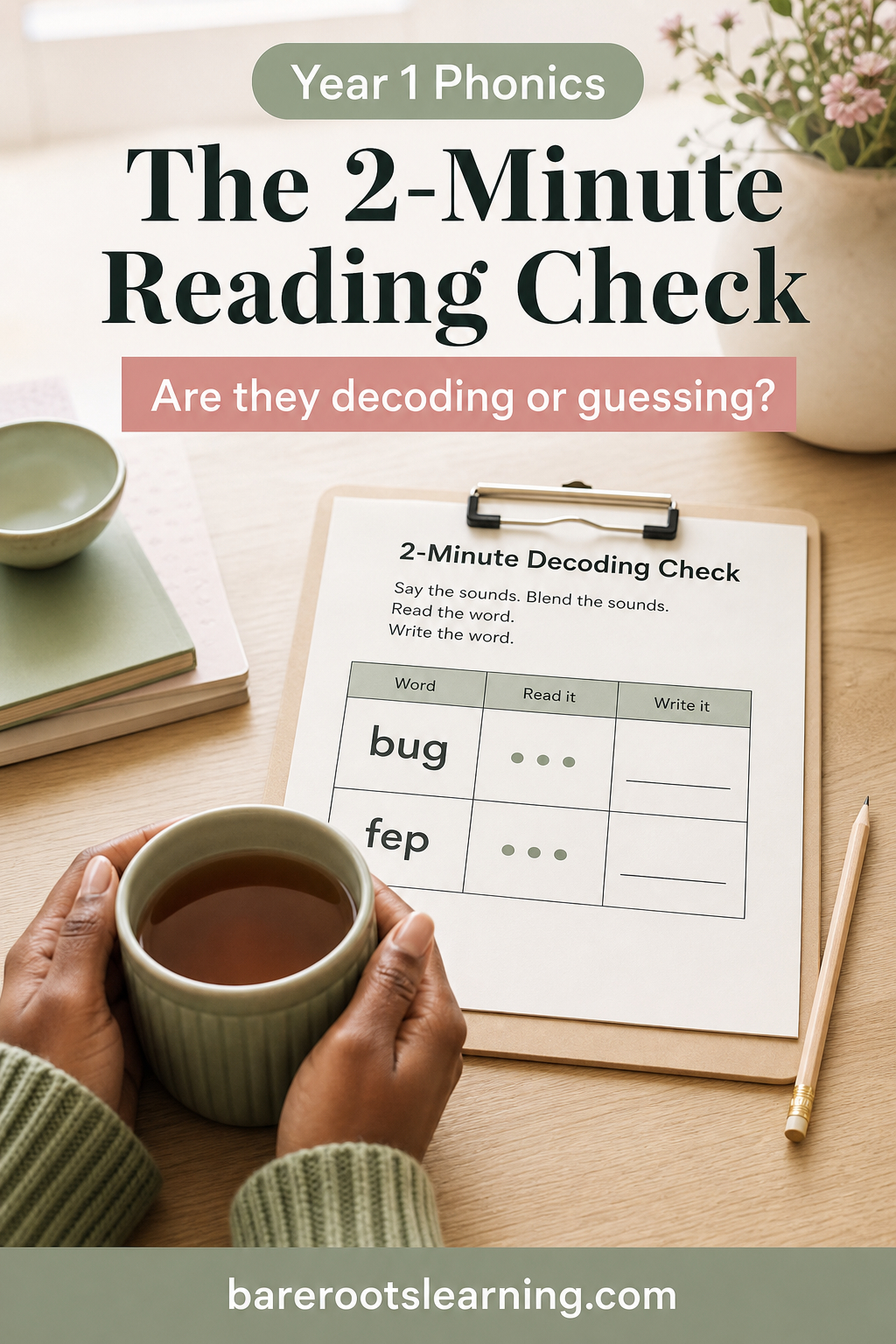
In reading research, there is a zero-prep tool used to assess pure decoding skills: nonsense words. Nonsense words are simply made-up pseudo-words like “gan,” “bloff,” or “fep”. Because a child cannot possibly recognize a nonsense word by sight, reading these made-up words forces them to apply true letter-sound knowledge. It removes all picture clues and provides honest proof of real decoding without relying on memory or guessing.
The Step-by-Step Kitchen Table Diagnostic
Here is a simple, 2-minute diagnostic assessment you can do right now using just a piece of paper and a pencil.
- Step 1: Write the Real Words. Write down a list of familiar consonant-vowel-consonant (CVC) real words, such as “cat,” “pin,” “bug,” and “wet”.
- Step 2: Write the Nonsense Words. Directly below that list, write out a few nonsense CVC words, such as “lut,” “baf,” “gop,” and “kem”.
- Step 3: Hide and Read. Fold the paper or cover the bottom half so the nonsense words are hidden while your child reads the real words. Have your child point to each real word and read it from left to right without rushing.
- Step 4: The Decoding Flip! Reveal the nonsense words and ask them to read those next.
How to Read the Results
If your child effortlessly reads the real words but completely stumbles, freezes, or guesses when looking at the nonsense words, they are caught in the sight-word memorization trap. They haven’t mastered decoding yet, and that is absolutely fine! It simply means they need to pivot away from flashcards and focus on explicit, systematic speech-to-print mapping.
Cognitive reading research proves that reading mastery is demonstrated when a child can decode nonsense words with high accuracy, proving they truly understand the phonetic code rather than relying on their visual memory.
Ready to stop the reading guesswork? If you want a beautifully clean, printable version of this exact assessment, grab the free Homeschool Blending Toolkit. It includes the complete 2-Minute Decoding Diagnostic Grid so you can find out in minutes whether your six-year-old is truly decoding or just guessing!