

Short Vowel Sounds: A Simple Sorting Activity
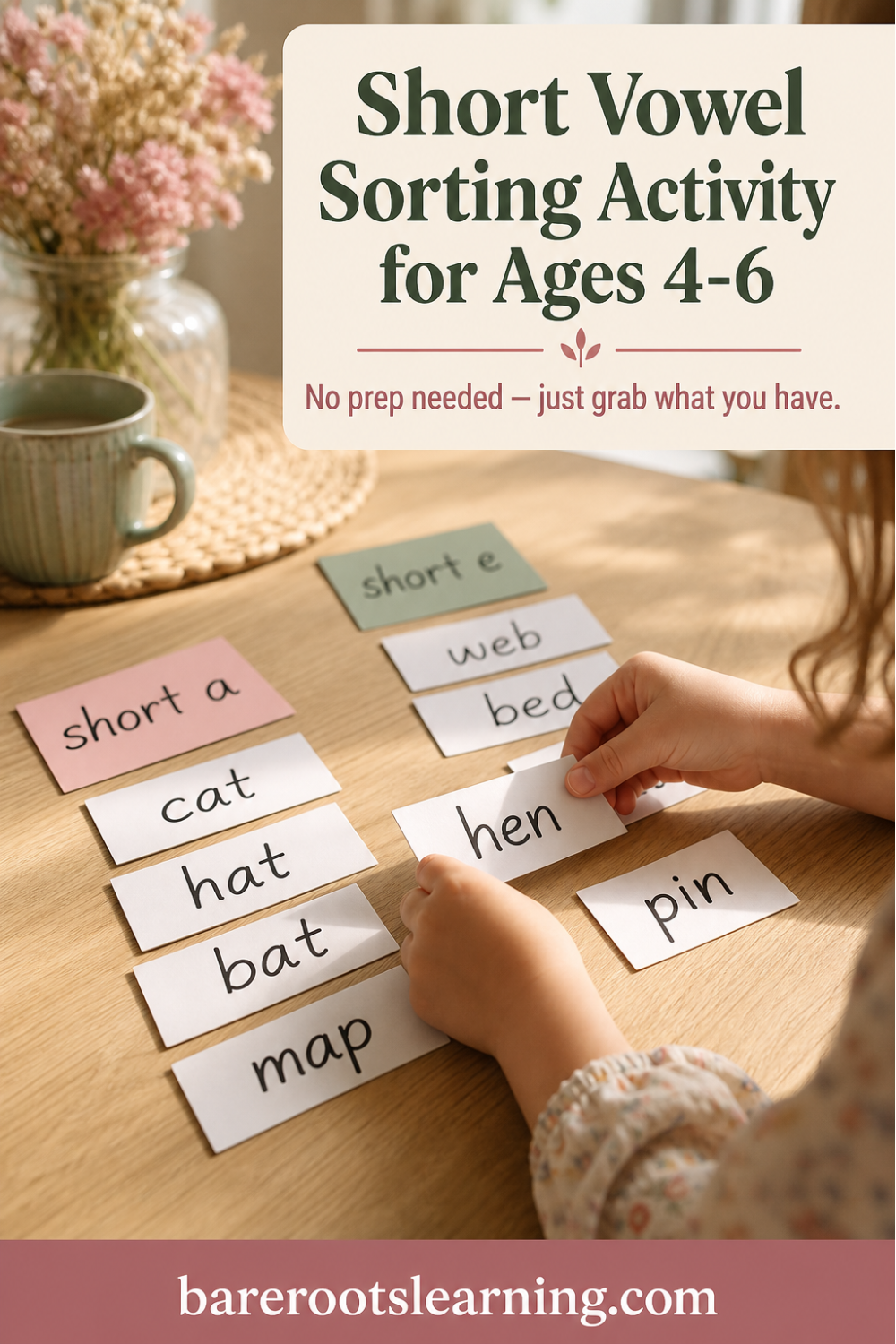
Short vowels are where a lot of young readers get stuck. And honestly? It makes complete sense. Five different vowel sounds, all written with just one letter each, and several of them sounding remarkably similar.
This simple sorting activity takes about ten minutes, needs no special equipment, and directly targets the confusion before it becomes a habit.
What You Need
- A handful of small word cards (index cards cut in half work perfectly)
- A pencil
- Five minutes to write the words beforehand
- That’s it
No laminator. No printer. No prep the night before.
The Activity: Short Vowel Sort
Write ten to fifteen simple CVC words on your cards – two or three words for each short vowel. Keep them clearly decodable. Here are some to start with:
Short A: cat, map, bag, hat, pan Short E: hen, bed, leg, ten, pet Short I: pin, sit, lid, bin, fig Short O: hot, dog, mop, pot, log Short U: cup, run, bug, mud, sun
Shuffle the cards and place them face down in a pile.
Your child picks a card, reads the word aloud, identifies the vowel sound in the middle, and places it in the correct column. You can draw five column headers on a piece of paper – a, e, i, o, u – or just use five separate spots on the table.
Why the Middle Sound Is the Key
Short vowels sit in the middle of CVC words (consonant-vowel-consonant), and that middle position is where most reading errors happen. Children often read the first and last consonants correctly but swap or skip the vowel entirely.
By asking your child to listen for the middle sound specifically, you’re training their ear to pay attention to the part of the word they’re most likely to glide over. This directly strengthens phonemic awareness – the ability to hear and identify individual sounds inside words.
Making It a Little Harder
Once your child can sort confidently, try these variations:
Without the cards. Call out a word and ask them to hold up the correct number of fingers (1 for short a, 2 for short e, and so on). No visual support – just listening.
Add a nonsense word. Slip in a made-up word like “fep” or “nud.” If they can sort a nonsense word correctly, they’re definitely listening to the sound and not purely relying on word recognition.
Timed challenge. How many cards can they sort correctly in two minutes? Children who find this activity easy often love the added pressure of a timer.
What to Do When They Get Stuck
If short e and short i are causing confusion – and they often do, because those two sounds are genuinely close together – slow right down.
Say the target word slowly and hold the vowel sound: “heeeen.” Ask your child to notice what their mouth is doing. Then try the other vowel in the same frame: “hiiiin.” Is that a real word? No. So it must be “hen.”
This process of comparing two similar sounds explicitly is far more effective than simply correcting a wrong answer and moving on.
The Bigger Picture
Short vowel mastery is one of the clearest milestones in early phonics. A child who can reliably identify and produce all five short vowel sounds is ready to move into blending full CVC words with confidence – and from there, into digraphs, blends, and beyond.
This activity is one small piece of that progression. Consistent, short practice sessions – ten minutes, three or four times a week – build the discrimination skills that longer, less frequent drilling simply cannot.
Grab the free Homeschool Blending Toolkit – a four-page introduction to sound mapping that you can use today. Just enter your details below to get immediate access.