

5 CVC Word Activities You Can Do With No Prep Or Printer
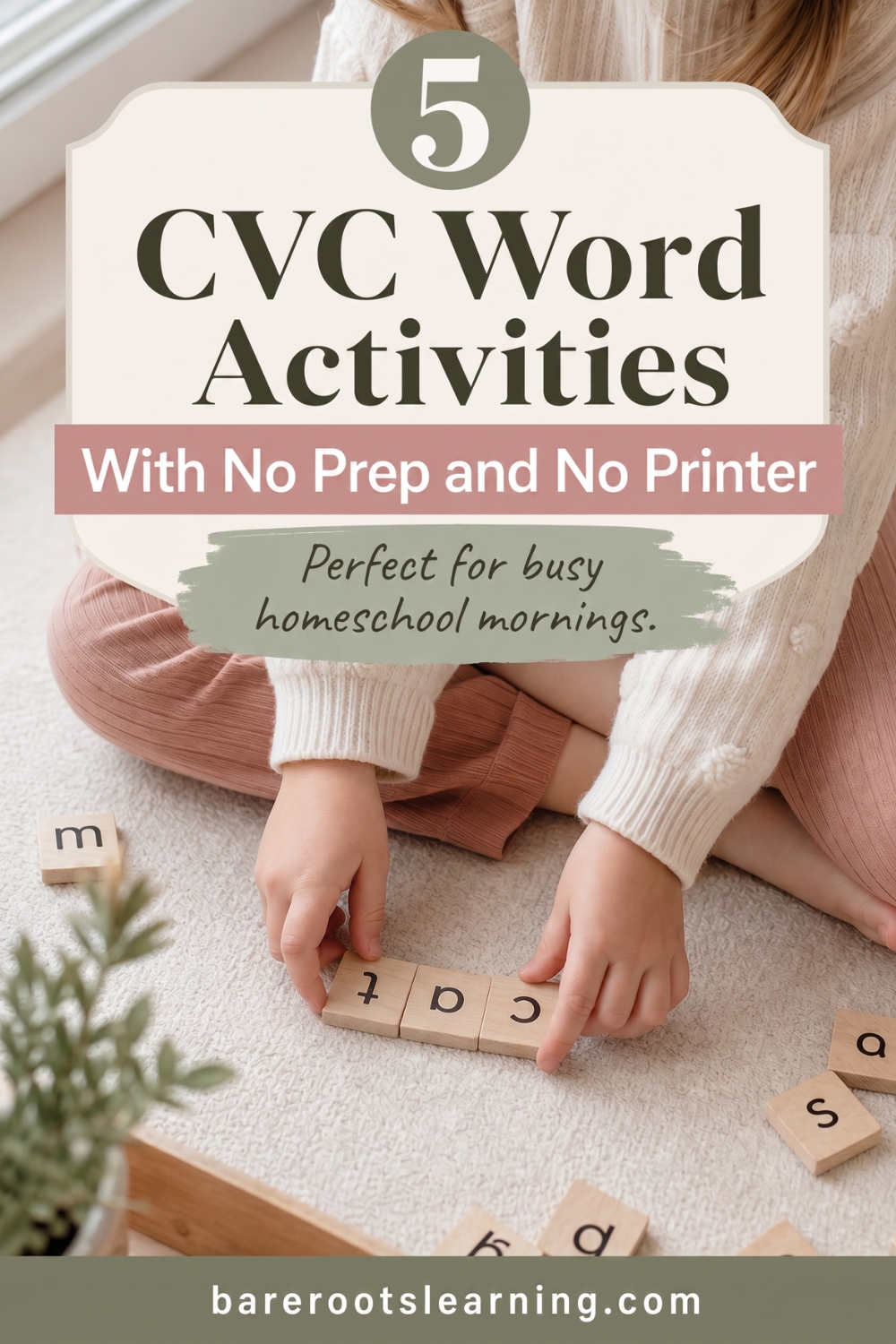
Some of the best phonics practice happens nowhere near a worksheet. If your printer is out of ink, your laminator is buried in a cupboard, or you simply need something to do right now – these five activities use only what you already have at home.
All five target CVC words (consonant-vowel-consonant – simple three-sound words like cat, pin, hop). They’re ideal for ages 4–6 and take less than ten minutes each.
1. Build It With Letter Tiles
If you have a set of wooden or magnetic letter tiles, this is the simplest place to start.
Call out a CVC word and ask your child to build it using the tiles. Say it slowly – “/c/… /a/… /t/” — and ask them to find one tile for each sound they hear.
The physical act of selecting and placing letters reinforces the left-to-right sequencing of print, the one-letter-per-sound relationship, and fine motor control all at once. When they’ve built the word, ask them to read it back by sweeping a finger under the tiles from left to right.
Swap one tile and ask them what the new word says. This “word swap” variation is excellent for building flexibility – and children love the puzzle of it.
2. Tap It Out on Their Fingers
No equipment needed at all for this one – just hands.
Ask your child to hold up one hand, fingers spread. Say a CVC word aloud. They tap one finger at a time for each sound they hear – thumb for the first sound, index finger for the second, middle finger for the third.
Then ask them to blend it. Starting from the thumb, they slide their other hand across all three fingers in one sweeping motion while saying the whole word.
This works because it makes the abstract process of blending physically visible. The three sounds are literally in front of them, and the blending gesture gives their brain a physical anchor for what “pushing sounds together” actually feels like.
3. Write in a Tray of Salt or Sand
Pour a small amount of table salt or fine sand into a shallow tray or baking dish. Call out a CVC word and ask your child to write it in the tray using their finger.
The multisensory element – the texture, the sound of the finger moving through the salt, the visual of the letters forming – engages more of the brain than pencil on paper alone. This is especially useful for children who find standard writing practice frustrating or tiring.
Mistakes are satisfying to fix: one quick shake and the slate is clean again.
4. Odd One Out
Write or say three words – two that share the same vowel sound and one that doesn’t. Ask your child to identify the odd one out.
For example:
- cat / hat / hit (odd one out: hit — short i, not short a)
- pin / tin / ten (odd one out: ten — short e, not short i)
- hop / hot / hut (odd one out: hut — short u, not short o)
This activity is deceptively challenging because it requires your child to hold three words in working memory, isolate the vowel sound in each, compare them, and make a judgement. It builds phonemic awareness more actively than simple reading or writing tasks.
You can do this entirely orally while driving, cooking, or walking!
5. Change One Sound
Start with a simple CVC word and take turns changing one sound at a time to make a new word. This is sometimes called a “word chain” or “word ladder.”
For example:
- cat → hat → hit → bit → bat → bad → bid
The rule: you can only change one sound per turn – the beginning, the middle, or the end. If your child can’t think of a word, you take a turn and keep the chain going.
This game builds phoneme manipulation – the ability to consciously swap sounds in and out of words – which is one of the strongest predictors of later reading success. And because it’s a back-and-forth game rather than a task, it rarely feels like work.
A Quick Note on “No Prep”
None of these activities require advance preparation – but all five work better when they’re used consistently. A ten-minute session three or four times a week builds far more skill than an occasional longer session.
Get started with the free Homeschool Blending Toolki
[Download for free by entering your details below →]