

8 Creative Writing Prompts for 7-Year-Olds
Staring at a blank, unlined piece of paper is incredibly intimidating for a seven-year-old. You lovingly hand them a beautiful, empty journal expecting a wonderful story about a dragon or a spaceship, but instead, they completely freeze, stare at the ceiling, or dissolve into frustrated tears.
This isn’t stubbornness, and they aren’t trying to be difficult! At age seven, your child is in the midst of a massive cognitive transition. To write a sentence, they must hold a creative thought in their working memory, segment every single sound they want to spell, remember complex orthographic rules (like vowel teams and digraphs), and execute the fine motor movements to form the letters.
Expecting a young mind to juggle all of that while generating a brilliant creative narrative from scratch causes severe cognitive overload. The secret to getting your seven-year-old to write creatively without the kitchen-table battles is heavy scaffolding – reducing the mental strain so they can actually focus on the fun part.
Before we dive into the prompts, make sure you are using the right paper! Because your seven-year-old’s fine motor control is still maturing, provide them with “dotted thirds” guidelines scaled specifically to 12mm (a solid top line, a dotted middle line, and a solid bottom line). This spatial scaffolding gives them the boundaries they need to succeed independently.
Here are 8 highly structured, stress-free prompts that will break the blank-page panic today.
- The “Silly Sentence” Choice Remove the pressure of inventing a whole concept by giving them a base sentence and a word bank of absurd options to choose from. For example, present them with: “The little [lamp / bench / sign / fence] told riddles to the mailman”. Let them circle their favorite ridiculous option and then copy the entire silly sentence onto their guidelines. It feels like a game, but they are practicing essential encoding skills!
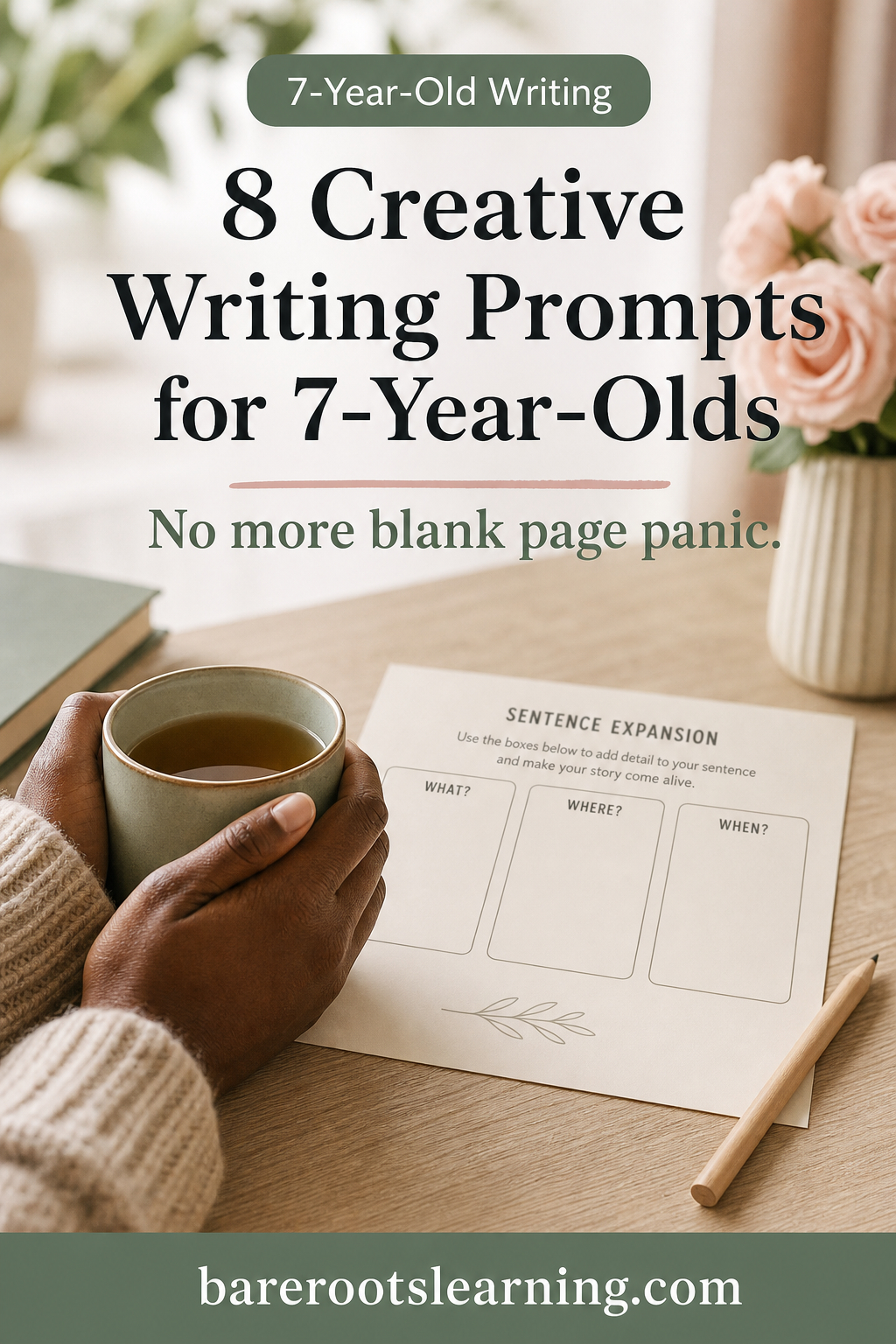
- The Sentence Expansion Trick Give your child a tiny, boring base sentence, such as: “A mouse squeaked”. Next, gently prompt them to make it stronger by asking three questions: What kind? Where? When?. They write their simple answers in small boxes (e.g., grey, softly, under the bed). Finally, they combine it all into a beautifully expanded, conventional sentence: “A grey mouse squeaked softly under the bed.”. Step-by-step, they build a robust narrative without ever feeling overwhelmed.
- Draw First, Write Second A blank writing line is scary; a blank drawing box is an invitation. Ask your child to draw a scene – perhaps a swan gliding across a calm, still lake. Drawing acts as a low-pressure, visual brainstorm. Once they finish, have them write two simple labels for objects in their picture (e.g., “swan”, “lake”). Finally, use those labeled words as the anchor for them to write one creative sentence about what is happening in their artwork.
- The “Five Finger” Story Spin Read a short book together and use a “Five Finger Retell” to break down the story: Characters, Setting, Problem, Events, Solution. Once you have mapped out the original story together, ask your seven-year-old to change just one element – like swapping the setting from a forest to a space station – and write a few sentences about how the story would end differently.
- The “Fix It and Finish It” Challenge Write a messy sentence with absolutely no capital letters or punctuation, such as “the ship set sail”. Ask your child to act as the teacher and rewrite the sentence perfectly on the line below (“The ship set sail!”). Once they have fixed the grammar, challenge them to write one creative sentence detailing exactly where that ship is going.
- The “What Do You Know?” Word Bank Ask your child a simple, factual question like, “What do you know about the sun?”. To prevent spelling panic, provide a small, targeted word bank on the side of the page (e.g., hot, sky, light, warm, shine). Provide a couple of sentence starters for them to finish (“I see a sun…”, “I like the sun because…”), and then give them a final blank line to write their own independent, creative thought using the word bank.
- KWL Chart Story Starters Pick an interesting animal or topic and fill out a KWL Chart together: What I Know, What I Want to Know, What I Learned. Sit together and brainstorm the “Want to Know” column. Use their most imaginative question as the starting prompt for a creative, fictional story.
- The Cut-and-Paste Scramble Write a fun, descriptive sentence, cut out the individual words into physical tiles, and mix them up on the table. Ask your child to physically sequence the word tiles into a logical sentence, glue them down, and then write the sentence freehand beneath it. Physically manipulating the words externalizes their mental load, and physically writing the sentence afterward acts as the “neural glue” that permanently bonds the spelling and reading pathways in their brain.
Remember, your seven-year-old’s developing brain optimizes learning in short, high-frequency micro-bursts. Keep these writing sessions strictly capped at 10 to 15 minutes. Stop the activity while they are still successful and feeling proud of their story to build their confidence for tomorrow!