

Stop the Guessing: 3 Ways to Build Real Decoding Skills in Year 1
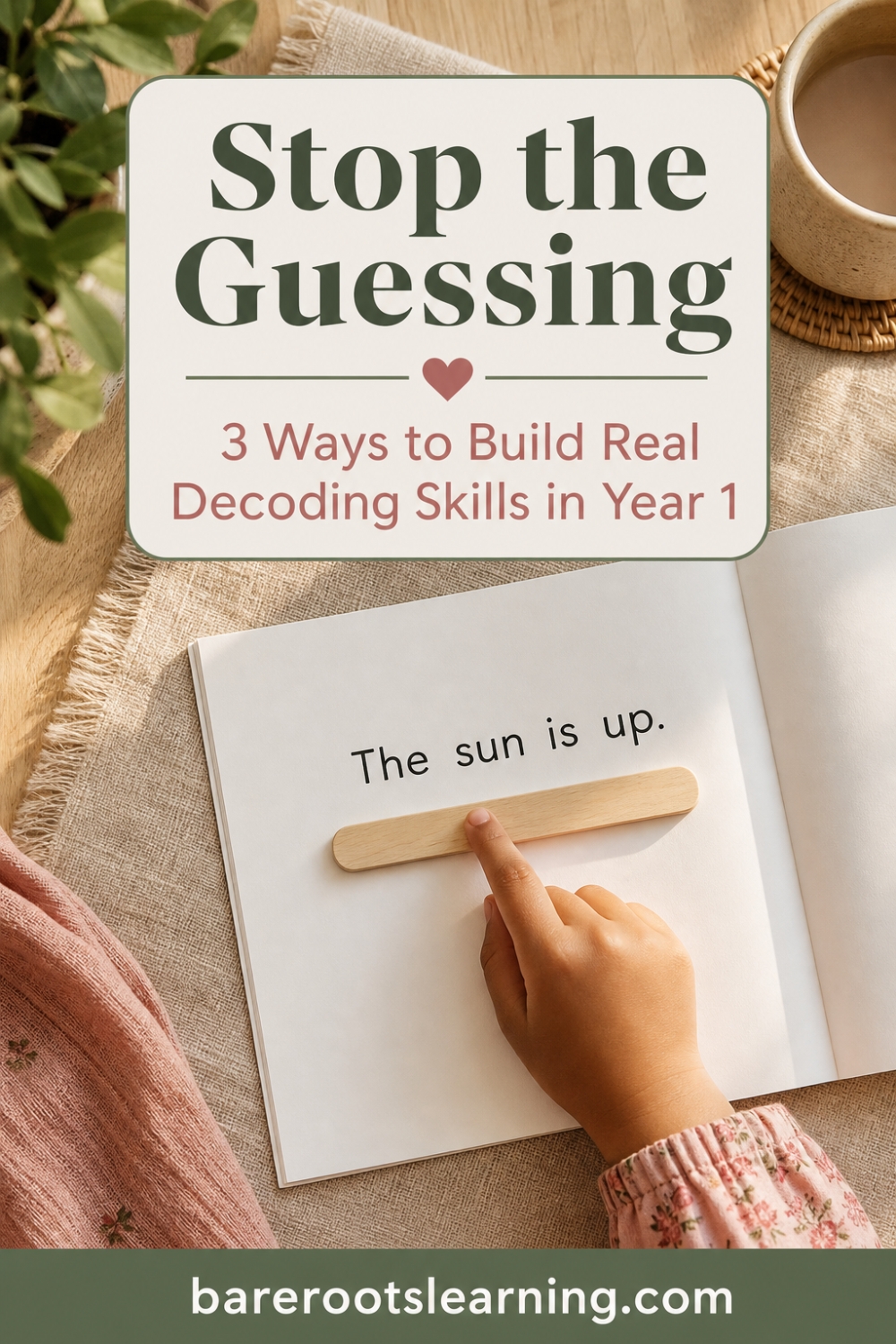
A common scenario: You are sitting at the kitchen table, reading together, and your child comes to the word “horse.” Instead of sounding it out, their eyes immediately dart up to the illustration, and they confidently shout, “Pony!”
This can be incredibly frustrating, especially when you have spent weeks working on phonics. But before you feel like you are failing, take a deep breath. Your child isn’t being lazy; their brain is just taking the path of least resistance. For decades, a now-debunked reading method known as “three-cueing” actually taught children to guess words using pictures, context, and first letters rather than decoding them.
Unfortunately, this guessing habit mimics the exact behavior of struggling readers. When children encounter older, text-heavy books without pictures, their reading comprehension collapses because they haven’t built the neural pathways for true decoding.
Here are three simple, screen-free ways to break the guessing habit and build a confident, real decoder at home.
1. Swap Predictable Books for Decodable Readers
To stop the guessing, switch entirely to decodable readers. These are books meticulously engineered to contain only the phonics patterns you have explicitly taught. If the word “duck” is in the book, your child has to physically decode /d/-/u/-/ck/ to read it. One builds a guesser; the other builds a reader.
2. Change Your Kitchen Table Prompts
- “Let’s look at the first sound.”
- “Can you tap the sounds on your fingers?”
- “Let’s slide through every letter from left to right.”
Looking for a free resource to get started?
The free Bare Roots Learning Homeschool Blending Toolkit includes a simple diagnostic page that helps you identify exactly which phonics stage your child is at – so you know which decodable books will be the right match right now.
[Download the free toolkit by entering your details below →]