

Teaching -ed and -ing: A Screen-Free Phonics Activity for 6-Year-Olds
Is your six-year-old comfortably sounding out simple words, only to completely freeze in panic when they encounter a longer word ending in “-ing” or “-ed”? Take a deep, reassuring breath! Your child hasn’t forgotten how to read, and you are not doing anything wrong – this is just a new reading skill your child must learn.
Between the ages of six and seven, children face a massive cognitive leap: the application of inflectional endings. Instead of just decoding simple consonant-vowel-consonant words, their brains must suddenly recognise that groups of letters (like -ed, -ing, or -s) attach to a base word to change its meaning or tense. This transition from simple one-to-one letter sounds to complex, multi-letter spelling patterns requires immense mental energy and can easily cause severe decoding fatigue.
Why Digital Apps Aren’t the Answer
When faced with this complex Year 1 milestone, it is incredibly tempting to hand over a tablet equipped with a flashy, gamified phonics app. However, in an educational market saturated with neon-hued digital applications, we must be cautious. These gamified “edutainment” tools often act as psychological hazards that exploit dopamine pathways, fragmenting a young child’s attention span and actively undermining their development of deep focus.
Furthermore, educational psychology warns us about the “seductive details effect”— – when visually complex, highly stimulating animations distract a child’s attention away from the actual letters and phonemes. When their fragile working memory is consumed by processing busy digital graphics, it actively degrades their ability to decode the target words and transfer those new spelling rules into long-term memory.
The Screen-Free Fix: The Morphology Matrix
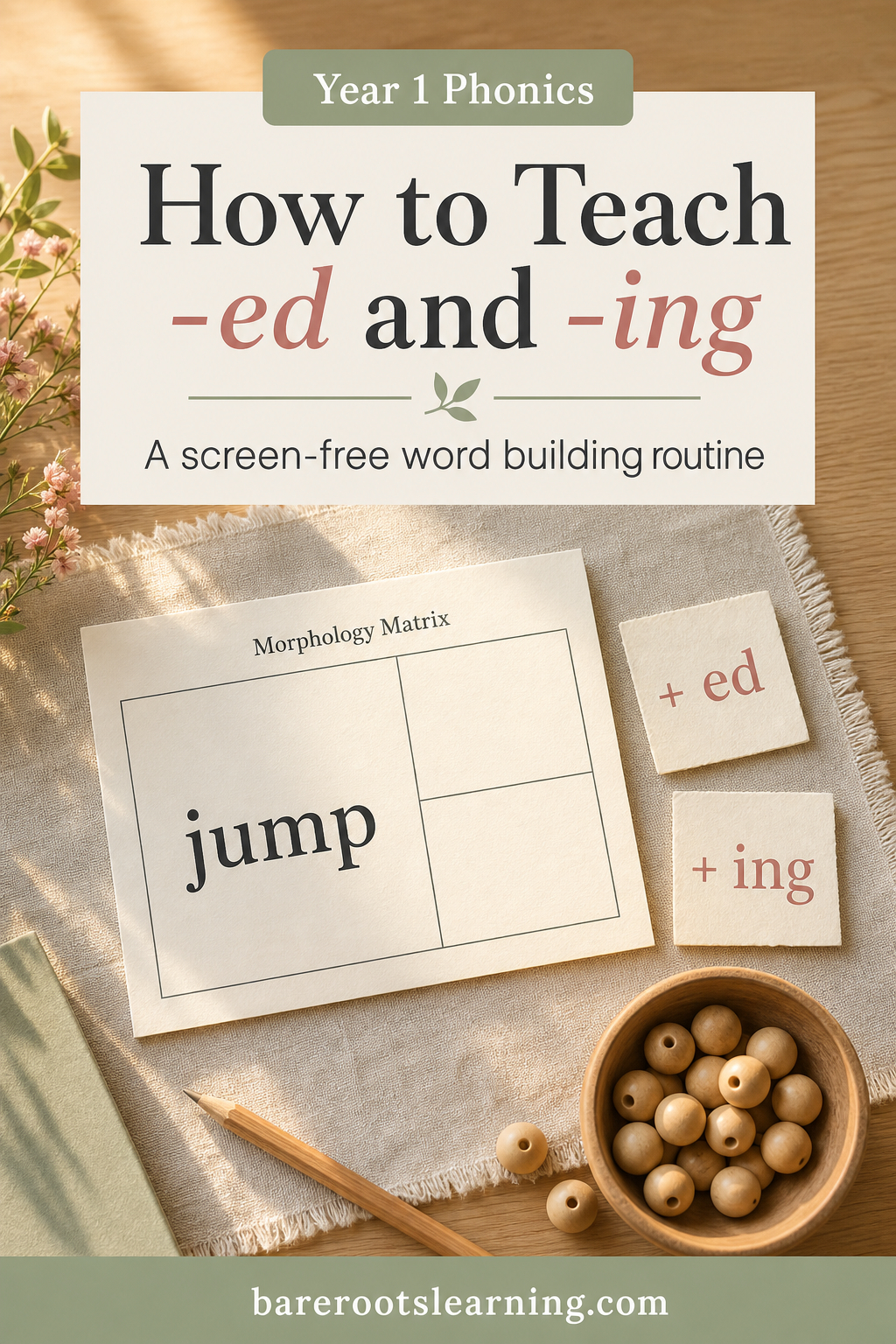
To safeguard your child’s neurological development and establish a calm, focused learning sanctuary at your kitchen table, we need to make these abstract word endings physically tangible. The most scientifically backed, screen-free way to introduce inflectional endings is through a highly structured “Morphology Matrix”.
A Morphology Matrix acts as a visual equation, showing a child exactly how a base word and a suffix combine to build a new word. It removes the guesswork and makes the structure of the English language beautifully logical.
A Simple 3-Step Routine for Your Kitchen Table
Here is a highly effective, screen-free routine you can use to introduce endings like -ed and -ing without the tears:
- Isolate the Base Word: Start by writing a simple, familiar base word on a piece of paper, such as “jump” or “farm”. Have your child trace their finger under the word and decode it first.
- Build the Word Sum: Introduce the suffixes as distinct, physical puzzle pieces. You can write the suffixes “-ed”, “-ing”, and “-er” on small, individual squares of cardstock. Have your child physically place the suffix next to the base word to create a “word sum” (e.g., jump + ed, jump + ing). This tactile manipulation provides vital physical feedback, aligning learning with their natural cognitive capacity.
- Write the New Word: Finally, have your child use their writing muscles to write the complete new word (e.g., jumped, jumping) freehand. Reading and spelling share a deeply interconnected neural highway in the brain. The physical act of spelling the word sound-by-sound acts as the cognitive “neural glue” that permanently bonds the word’s visual spelling and spoken sound together in their long-term memory.
And as always, it pays to remember that you do not need to drill these complex rules for 45 minutes! Cognitive research demonstrates that learning is vastly optimized when practice is kept to short, high-frequency “micro-training” bursts. A fast-paced, 10-to-15-minute session using this hands-on matrix is all it takes to protect their cognitive energy, prevent frustration, and build a confident Year 1 reader.