

Letter Formation: Why How Your Child Holds a Pencil Matters More Than You Think
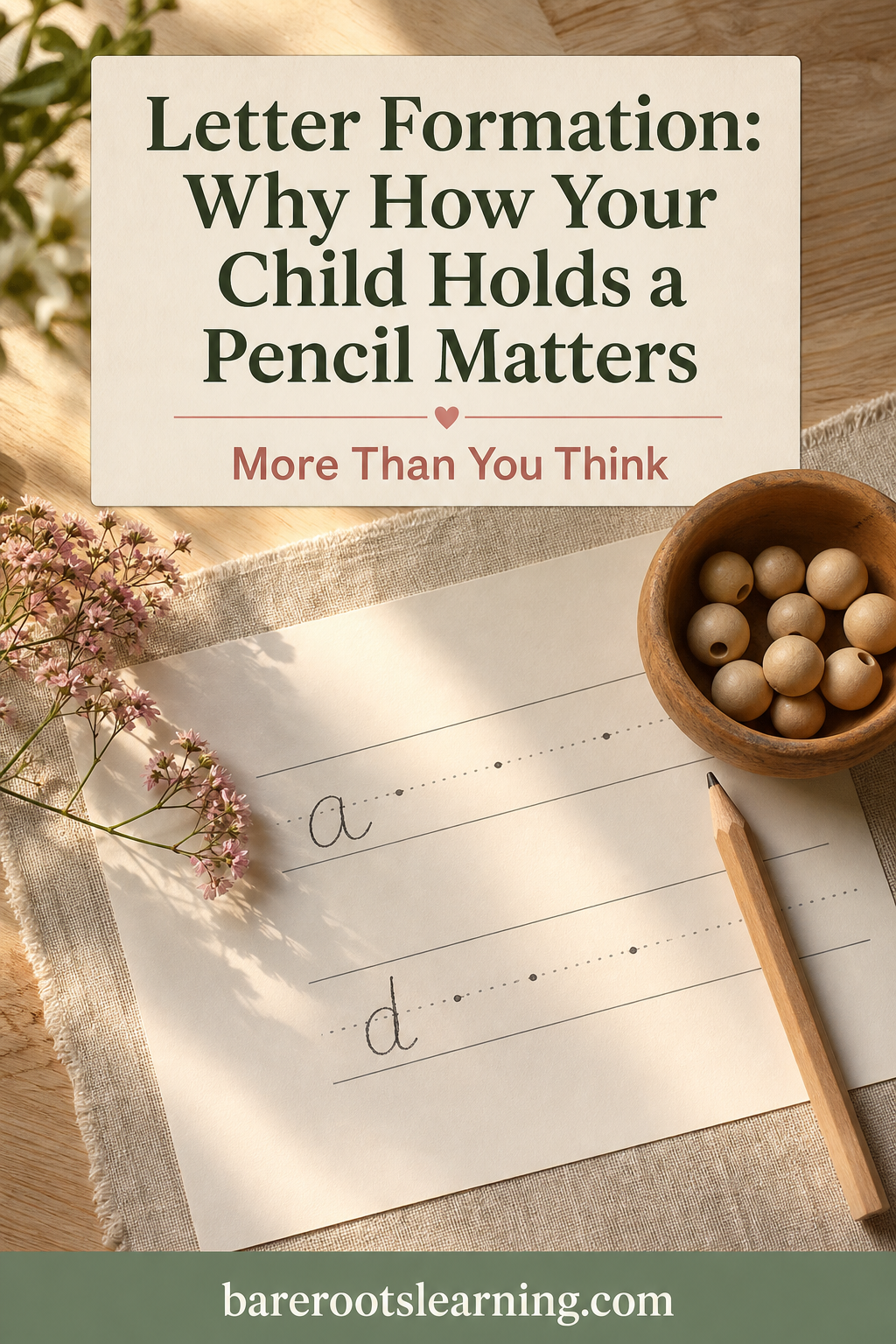
If you are sitting at the kitchen table watching your five-year-old painstakingly trace over a page of dotted letters, only to see them completely forget how to write that same letter five minutes later, you are not alone. It is incredibly frustrating to watch them put in the effort without seeing the results stick.
It is easy to assume they just need more practice tracing. But cognitive reading research reveals a fascinating truth: the way your child physically holds a pencil and forms letters from scratch matters far more to their reading journey than we ever realized.
Here is exactly why those traditional tracing worksheets might be stalling your child’s progress, and what to do instead to build true reading and writing confidence.
The Hidden Trap of Dotted-Line Tracing
Most commercial workbooks rely heavily on dotted-line tracing, assuming it is a gentle, necessary precursor to independent writing. It looks neat and feels productive. However, brain scans of preliterate five-year-olds show us a completely different story.
When a child simply traces over a dotted line, their brain follows a highly constrained, predictable motor path. It does not require their mind to actually plan and execute the physical shape of the letter. Because the brain isn’t doing the heavy lifting of planning the movement, the crucial “reading circuit” in the left hemisphere of their brain is not activated.
Why “Messy” Freehand Writing is Magic
When a child is asked to hold a pencil and write a letter completely freehand, the result is usually a bit messy, wobbly, and variable. But that “noisy” output is actually cognitive magic!
3 Simple Ways to Build Better Letter Formation Today To protect your child’s cognitive stamina and help them map letters permanently, we need to ditch the heavy tracing and move to intentional freehand practice. Here is a simple routine to use at your table this week:
1. Swap Tracing for a Starting Dot
Instead of having your child trace an entire word or a full line of letters, transition them quickly to freehand writing. Provide a single starting dot to show them exactly where their pencil should land to begin the stroke, and let them execute the rest of the shape independently.
2. Use Developmentally Sized Lines Young learners do not have the fine motor control for standard lined paper. Use paper with “dotted thirds” (a solid top line, a dotted middle line, and a solid bottom line) scaled to their age. A four or five-year-old needs a generous 24mm line height to accommodate their large, uncoordinated strokes, while a six-year-old can comfortably size down to 18mm.
3. Always Pair the Letter with Its Sound Never let writing be a silent activity. When your child’s pencil hits the paper to write the letter “m,” have them say the /m/ sound aloud simultaneously. Engaging their ear, their voice, and their hand all at once provides massive multi-sensory feedback to their developing brain.
As with everything else, keep writing sessions very short and highly focused. A few perfectly planned, independent letters are vastly superior to a full page of mindless tracing!