

How to Run a Phonics Lesson When Your Kid Won’t Sit Still
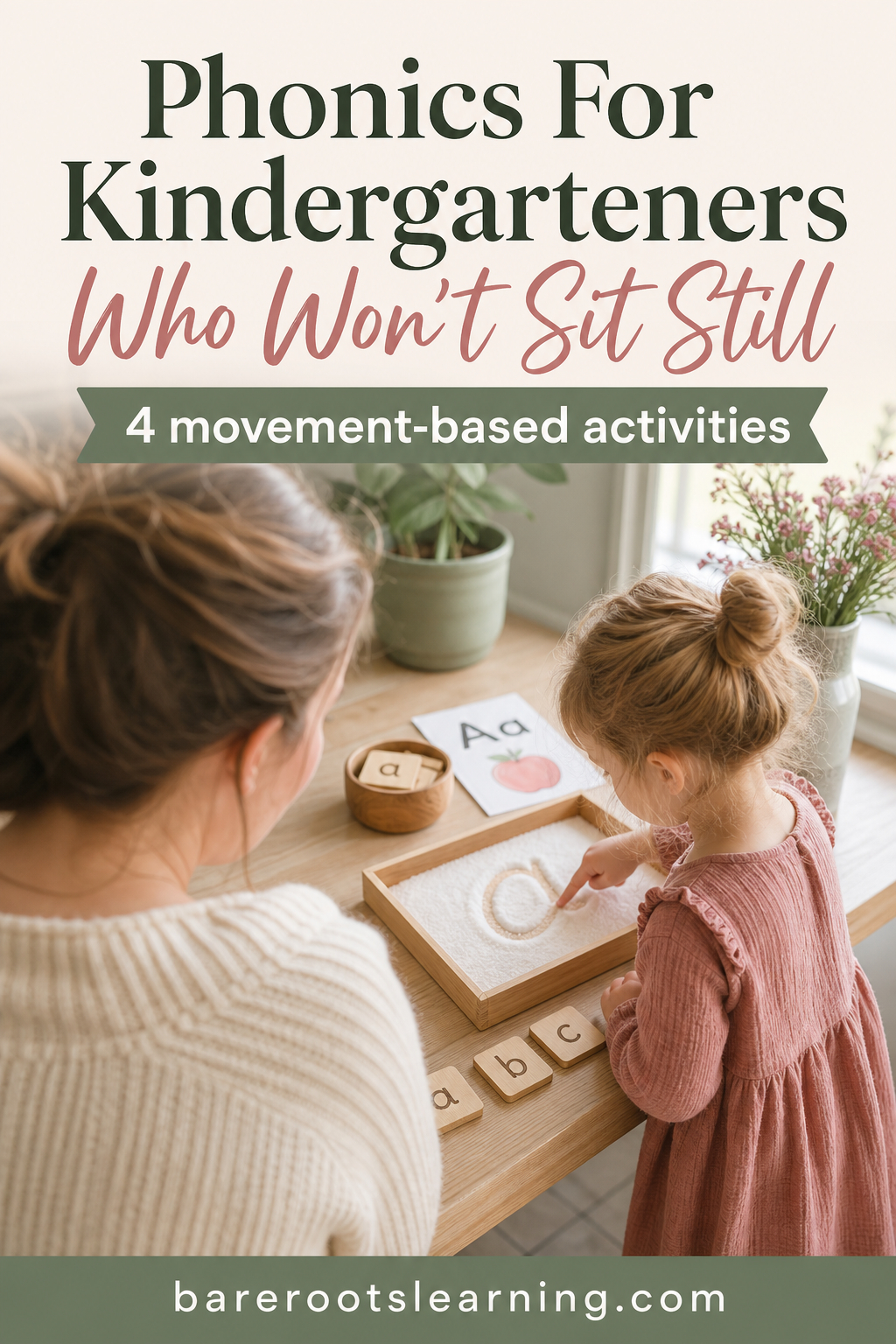
If you are trying to teach reading to a child who seems to be made of springs, constantly sliding out of their chair or bouncing around the kitchen table, you are definitely not alone! It is completely exhausting to try and manage a reading lesson with a frustrated, wiggly five-year-old, but their constant need for physical movement is not a sign of stubbornness.
The Science of the Micro-Session
First, let go of the idea that a reading lesson needs to be a long, seated affair. Expecting a five-to-six-year-old to engage in prolonged, continuous phonics drills for 30 to 45 minutes is counterproductive. Prolonged drills induce cognitive fatigue, frustration, and task-avoidance behaviors, causing a steep decline in accuracy and memory consolidation.
Instead, cognitive research demonstrates that learning outcomes are optimized when practice is structured in short, high-frequency “micro-training” bursts of just 10 to 15 minutes. You do not need them to sit perfectly still for half an hour; you only need a highly focused, fast-paced micro-session!
How to Add Movement to Your Phonics Routine
To make those 10 minutes incredibly effective, you can actually use their need for movement to your advantage. Tactile and kinesthetic pathways reinforce visual and auditory connections in the brain. Here are a few simple, movement-based ideas to keep your structure intact without requiring stillness:
- The Roller Coaster Blending Trick: When your child struggles to push sounds together, get their whole arm involved! In the roller coaster strategy, children physically mimic the movement of a roller coaster with their arm: going up the hill for the first consonant, peaking at the crest for the middle vowel, and sliding down for the final consonant. These physical inputs provide vital feedback to the motor cortex, reinforcing the abstract visual letter shapes in their memory.
- Syllable Clapping: Before a child can decode letters, their ears must be tuned to spoken sounds. However, asking a child to simply sit and “listen” for syllables can quickly exhaust their fragile working memory. Pairing the auditory task of hearing a word with a physical, tactile motion – like clapping – reduces cognitive strain and provides a brilliant foundation for reading readiness.
- Write the Room: Who says a worksheet has to be completed at the table? Tape numbered picture cards around the room and let your child go on a scavenger hunt. They can physically move around the space, find the numbered card, and then write the matching word on their paper.
- Keep Their Hands Busy: If you do need them at the table, externalize their mental load by giving them physical objects to manipulate. When mapping sounds into Elkonin boxes, have them physically slide tokens, press silicone buttons, or smash small balls of play-doh for every sound they hear. You can also ditch the pencil entirely and have them trace letters into a small wooden sensory tray filled with fine white salt, which provides an incredibly tactile, calming experience.
Ready to stop the sounding-out struggle? If you want to try these 10-minute micro-sessions but need the right visual tools to guide you, download the Free Homeschool Blending Toolkit. I have stripped away all the visual noise and distracting cartoons, leaving only minimalist, distraction-free tools so 100% of your child’s focus goes exactly where it belongs: on the letters and sounds.