

Why Spelling Accelerates Reading: A 3-Step Encoding Routine for Age 6
Have you ever watched your six-year-old successfully sound out a word in their reading book, only for them to completely freeze when asked to spell that exact same word five minutes later? It is a very common kitchen-table hurdle! It is so tempting to hand them a list of words to write out ten times each, or to use the old “look-cover-write-check” method. But treating spelling as a visual memorisation task completely overwhelms their developing working memory.
For years, reading (decoding) and spelling (encoding) were taught as entirely separate subjects. However, cognitive psychology shows us that reading and writing actually share a deeply interconnected neural highway in your child’s brilliant brain. In fact, research reveals that explicitly teaching spelling actively accelerates a child’s reading progress.
Here is why making this connection is so powerful, and a simple, screen-free routine you can use to build true literacy today.
The “Neural Glue” of Freehand Spelling
When a child reads a word, they can sometimes rely on partial visual clues or context to guess. But when they are asked to spell a word, guessing is impossible. Spelling forces their eyes and mind to pay close, precise attention to the exact letter and sound sequence from left to right.
When your six-year-old physically writes a word freehand, they are performing cognitive magic. They have to segment the spoken word into individual sounds, select the correct letters, and execute the fine motor movements to put those letters on paper. This physical process acts as the “neural glue” that permanently bonds the word’s visual spelling, auditory pronunciation, and meaning together in their brain’s visual word form area.
Crucially, this magic only happens with freehand writing. Brain scans reveal that tracing over dotted lines follows a constrained motor path and completely fails to activate the brain’s reading circuit. To build genuine reading fluency, we need to ditch the tracing and get them encoding!
The 3-Step Encoding Routine
To help your six-year-old confidently bridge the gap between spoken sounds and printed letters without tears or frustration, try this simple speech-to-print workflow.
- Step 1: Hear & Say Show your child a picture of a simple word (like “cat” or “duck”) or say the word aloud to them. Ask them to repeat the word slowly. This ensures their auditory processing is locked onto the correct sounds.
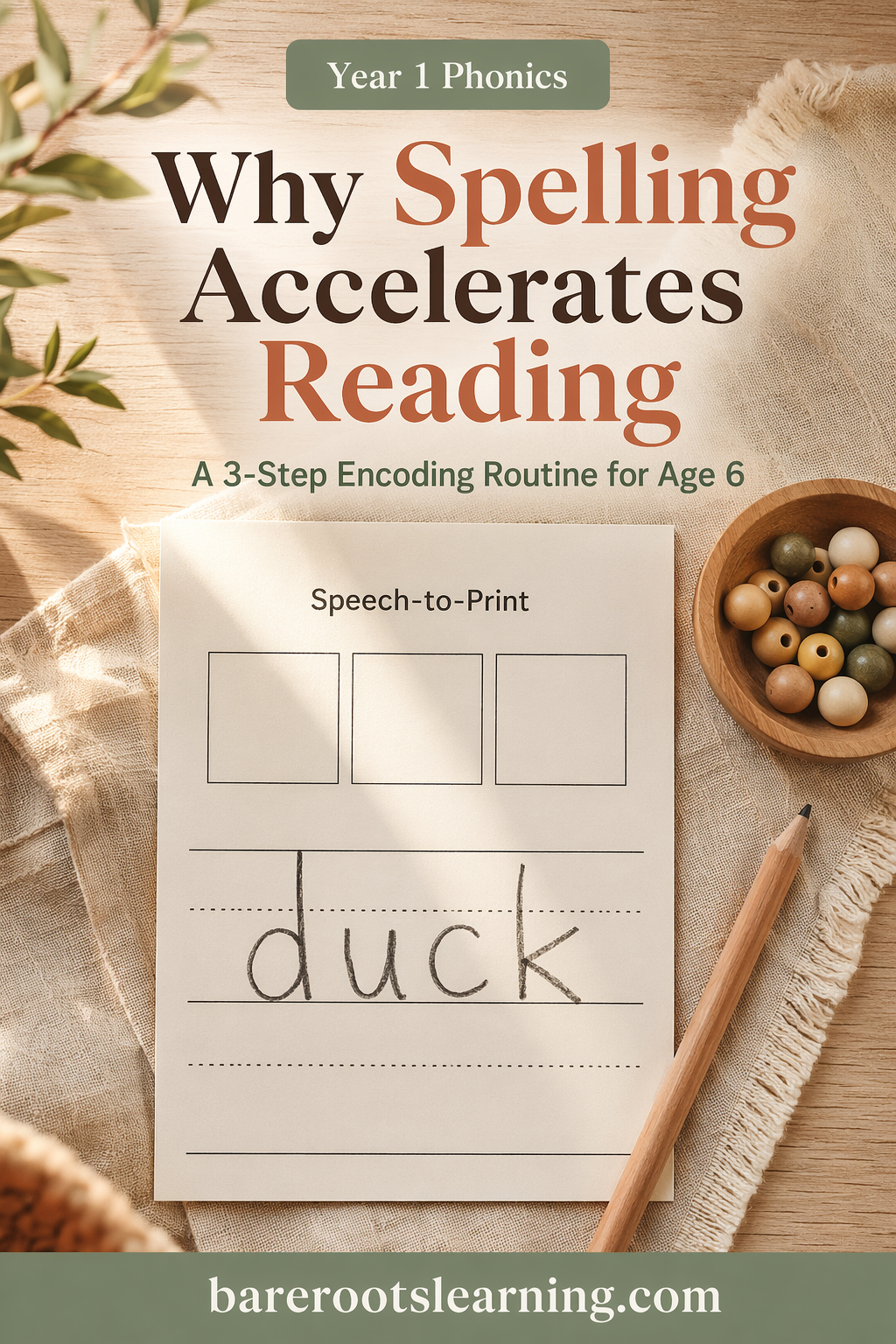
- Step 2: Segment & Map Ask your child to tap out the individual sounds they hear. Next, provide them with a row of blank Elkonin sound boxes (one box for every sound). Have them write exactly one letter or spelling pattern into each box as they stretch out the sounds. By placing the letters into distinct, bounded spaces, you instantly reduce their working memory load.
- Step 3: Write It Freehand Finally, ask them to use their writing muscles to write the complete word freehand. Because six-year-olds are still developing fine motor control, be sure to provide developmentally scaled guidelines, such as 18mm “dotted thirds” (a solid top line, dotted middle line, and solid bottom line). This gives them the spatial scaffolding they need to succeed without the restrictive crutch of tracing.
Ready to stop the spelling frustration? You do not need to spend hours planning complex writing lessons to build a fluent reader. By integrating this simple, 3-step encoding routine into your daily practice, you give your child the tools to permanently map words into their long-term memory. Grab our minimalist, zero-prep Homeschool Blending Toolkit today to access beautifully clean speech-to-print mapping mats that guide your child through this exact science-backed workflow!