

5 Simple Ways to Teach Consonant Blends to Year 1 Readers
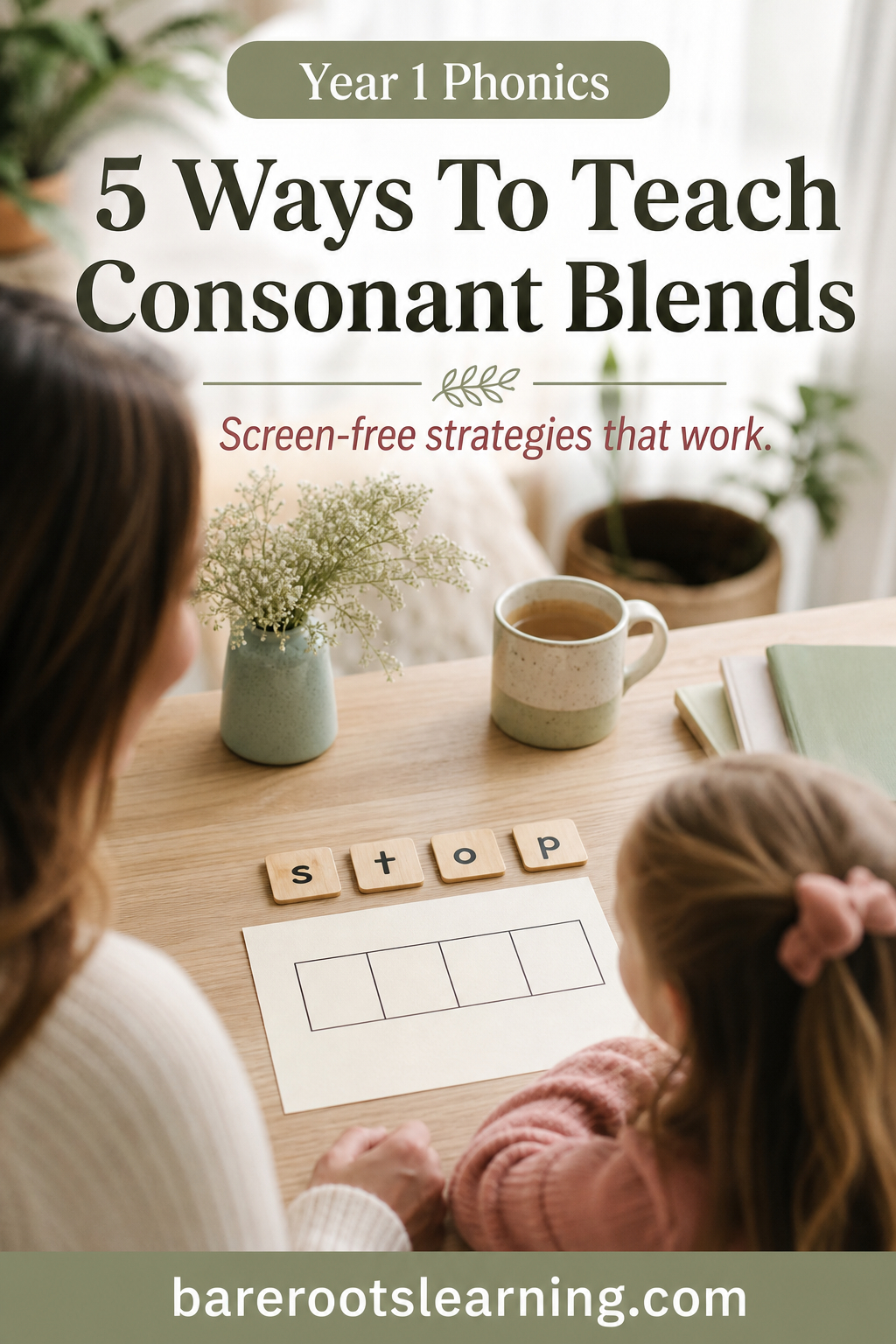
Is your six-year-old successfully reading basic three-letter words like “mat” and “bug,” but completely hitting a wall when they see “stop” or “flat”? It is a very common kitchen-table hurdle. Moving from three sounds to four is a massive leap for a young child’s working memory. When they encounter consonant blends, that extra letter requires extra mental energy, which can cause instant decoding fatigue.
A consonant blend is simply two or more consonants appearing together where each individual sound is still clearly pronounced, such as ‘st’, ‘fl’, or ‘mp’. Educational research shows that these should only be introduced after your child has firmly mastered basic short vowel patterns.Once they are ready for that next step, here are five simple, screen-free ways to help your Year 1 student smoothly transition to reading longer words.
- Physical Word Building Ditch the digital apps and grab some wooden letter tiles. Cognitive research proves that word-building activities using physical tiles significantly outperform standard worksheet drills. Having your six-year-old physically construct a word like “jump” phoneme-by-phoneme externalizes the mental load and makes the blending process highly concrete. Sliding each tile into place gives them a tactile anchor for every single sound.
- Word Chaining Games Word chaining is a powerful activity where you change just one letter to create a brand new word. You might start with a word they know well, like “lap.” Then, ask them to swap the ‘l’ for ‘f’ to make “flap,” and then swap the ‘a’ for ‘i’ to make “flip”. This fast-paced game forces your child to closely analyze the exact letter sequence and auditory substitutions, permanently cementing their understanding of English spelling.
- Use Sound Boxes (The Right Way) Elkonin sound boxes are incredible for mapping sounds, but blends often cause confusion. Unlike a digraph (where two letters team up to make one sound and share a single box), a consonant blend is made of distinct, individual sounds. This means in the word “stop,” the ‘s’ and the ‘t’ each get their very own square. Physically writing a letter into distinct, bounded spaces helps their mind visually and audibly segment those tricky adjacent consonants.
- Speech-to-Print Spelling Reading and spelling share a highly reciprocal neural highway. If your Year 1 student is struggling to read blends, have them spell them instead! Ask them to say the target word aloud, tap out the individual sounds, and write each letter freehand. Physically writing the word sound-by-sound locks the exact letter sequence into their long-term memory, ensuring they won’t have to guess the next time they see it in a book.
- Add a Physical Blending Motion When trying to push four sounds together, young learners often isolate each letter too much and forget the beginning of the word by the time they reach the end. Give them a physical motion to connect the sounds smoothly. The “roller coaster” arm motion – where their arm swoops up for the first consonants, peaks at the vowel, and slides down for the ending sounds – provides vital physical feedback to their motor cortex, helping them seamlessly connect that longer string of phonemes.
Protecting Their Cognitive Energy Remember, moving into complex spelling patterns demands a huge amount of mental energy. Keep these practice sessions to short, 10- to 15-minute micro-bursts to maintain their confidence and prevent task avoidance.
If you want to seamlessly integrate these science-backed mechanics right at your kitchen table, grab the free Homeschool Blending Toolkit. It provides the exact clutter-free, step-by-step sound mapping grids you need to build genuine decoding confidence today!