

Why Tracing Letters Is Holding Your Child Back (And What to Do Instead)
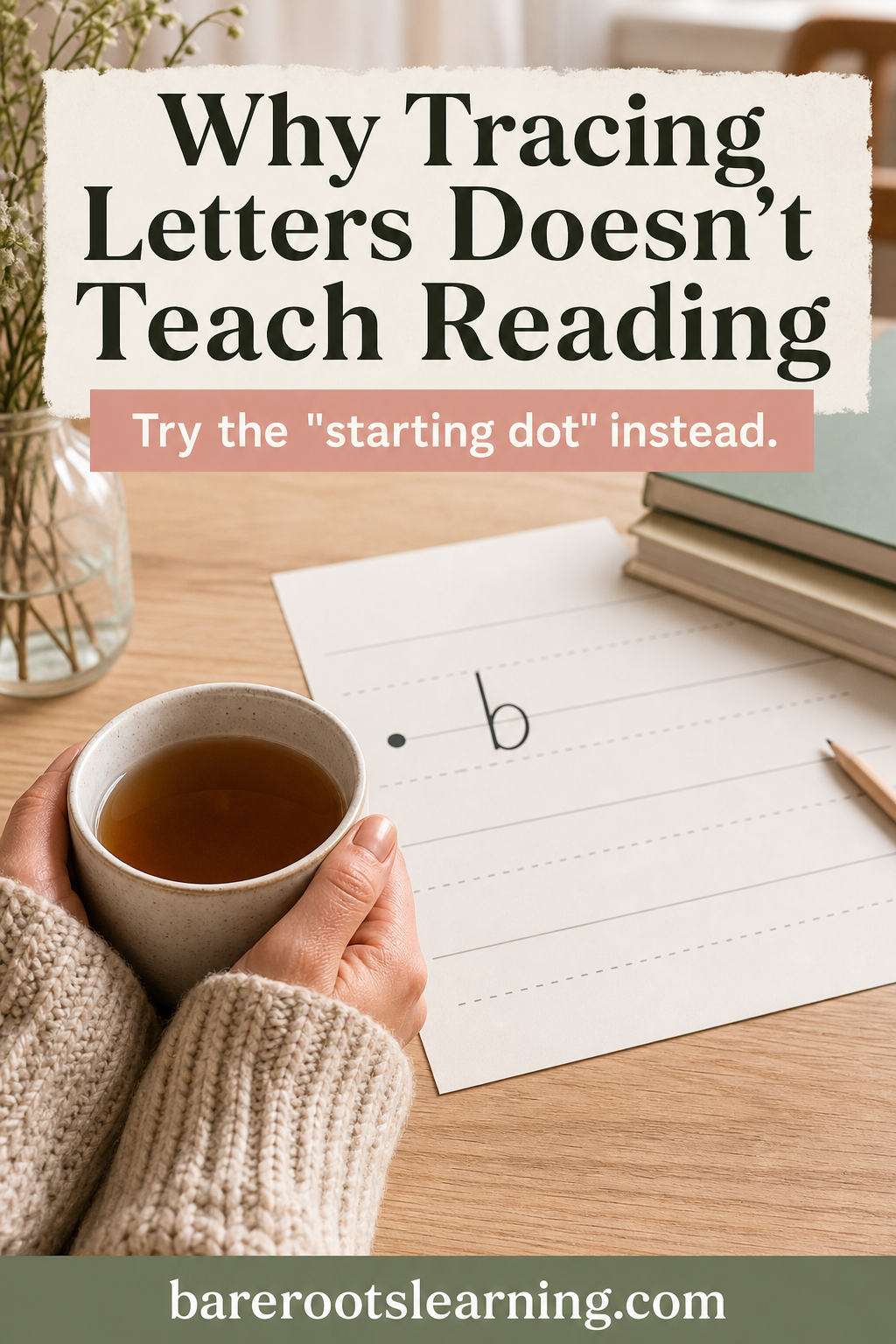
If you have ever sat at the kitchen table watching your five-year-old painstakingly trace over a page of dotted letters, only to ask them to write the same letter five minutes later and be met with a blank stare, you know exactly how exhausting it can be. You might wonder if they are simply not paying attention or if you need to drill them with more worksheets.
Take a deep, reassuring breath! Your child isn’t doing anything wrong, and neither are you. It turns out that those ubiquitous dotted-line tracing worksheets might actually be bypassing the exact part of the brain your child needs to build true literacy. Here is the fascinating cognitive science behind why tracing isn’t working, and the simple, screen-free shifts you can make today to build genuine writing and reading confidence.
The Problem with Tracing
When we look at functional Magnetic Resonance Imaging (fMRI) brain scans of preliterate five-year-olds, cognitive researchers see a profound neurodevelopmental difference between freehand writing and tracing.
When a child traces over dotted lines, they are simply following a highly constrained, predictable motor path. Because the path is already laid out for them, their brain doesn’t actually have to independently plan or execute the movements. Crucially, brain scans reveal that simply tracing letters does not activate the brain’s “reading circuit” – specifically the Visual Word Form Area in the left hemisphere. Ultimately, tracing is just a passive mechanical tracking exercise, not a reading one.
Why “Messy” Freehand is Cognitive Magic
If we want to build true reading and writing skills, children need intentional, freehand practice. When your child writes a letter freehand, their output is inherently a bit variable, noisy, and wobbly. But don’t break out the eraser! That “messy” handwriting is actually cognitive magic.
The mental effort it takes to create that wobbly letter independently forces the brain to broaden its category boundaries, which is exactly what allows your child to easily recognize letters across diverse fonts and handwriting styles later on. Freehand writing is not just a motor output; it is a vital cognitive “anchor” that binds the visual shape of the letter to its spoken sound in their memory, directly accelerating both their reading speed and spelling accuracy.
What to Do Instead (The Simple Kitchen-Table Fix)
You can easily swap frustrating tracing exercises for brain-building freehand practice using a few simple adjustments to your daily routine:
- Swap Full Tracing for a “Starting Dot” Instead of giving your child entire dotted words or letters to trace, transition rapidly to using just a single starting dot. Showing them where to place their pencil to begin, and asking them to generate the rest of the letter freehand, forces their brain to actively map the letter’s shape without overwhelming them.
- Use “Dotted-Thirds” Guidelines To help their young hands develop proper letter height and spatial alignment, use “dotted thirds” guidelines—a solid top line, a dotted middle line, and a solid bottom line.
- Scale the Lines to Their Development Four- and five-year-olds are still developing their fine motor control, so standard lined paper is often much too small and leads to massive frustration. Start with generously scaled 24mm dotted-thirds to accommodate those large, uncoordinated strokes. As they turn six and their fine motor control matures, you can gently reduce the line height to 18mm.
Ready to ditch the tracing fatigue? If you want to support your early reader with beautifully clean, distraction-free resources, download the Free Homeschool Blending Toolkit today! It provides a complete, open-and-go system that completely skips the tracing busywork. It includes my reusable “Read, Map, Write” template, allowing your child to practice true, screen-free letter formation on properly scaled guidelines. It is everything you need to anchor those letters in their memory with zero tears!