

From Words to Sentences: A Gentle Writing Transition for 6-Year-Olds
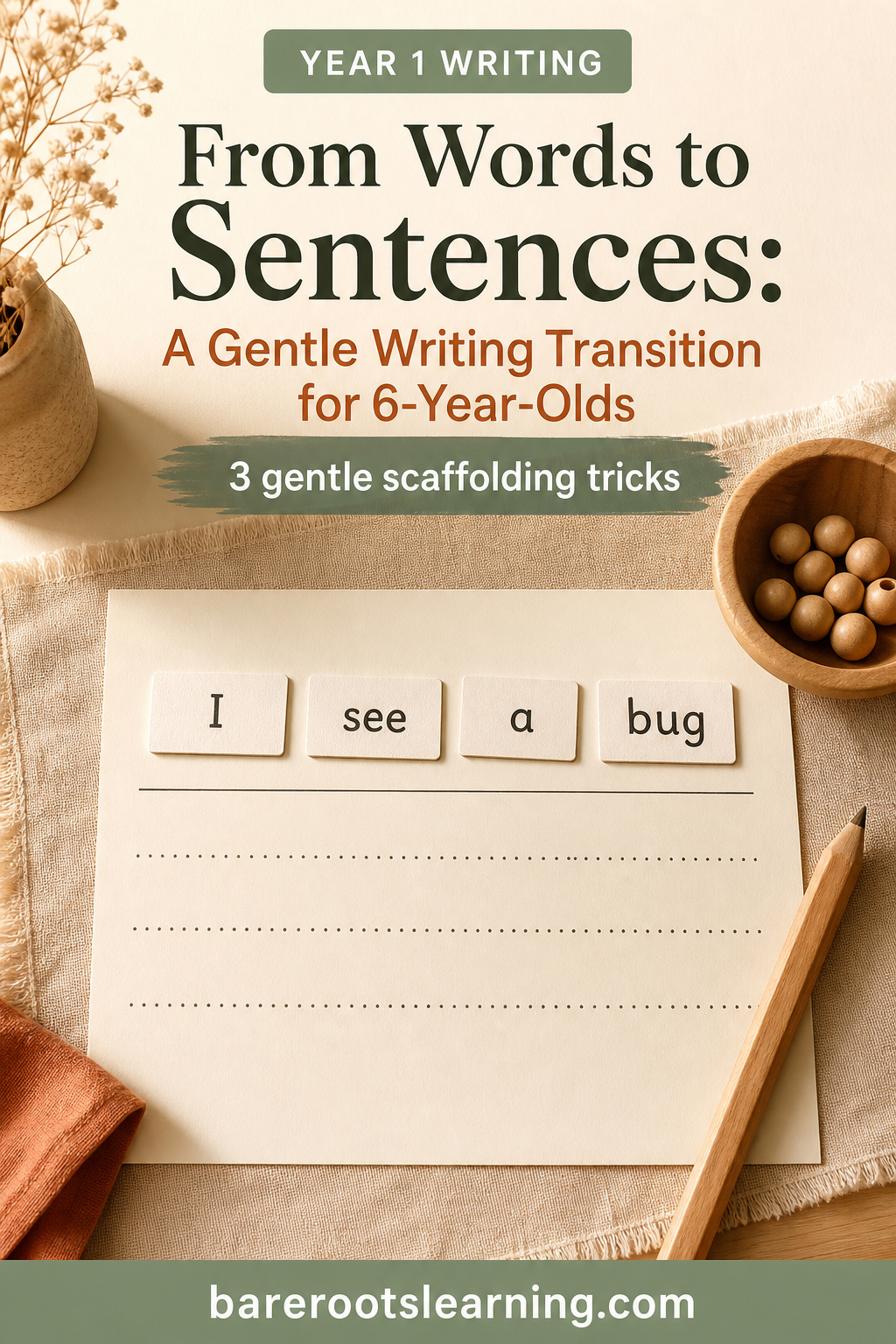
Have you ever watched your six-year-old confidently write “cat” or “bug” in isolation, only for them to completely freeze or become overwhelmed when asked to write a full sentence? It is a very common kitchen-table hurdle! Moving from encoding single words to crafting a complete thought is a massive leap for a young child.
The Cognitive Bottleneck
Let’s look at the cognitive science. To write a sentence, a six-year-old must hold the thought in their working memory, segment every single sound, remember the irregular spellings of high-frequency “heart words”, execute the fine motor movements to form the letters freehand, and remember to add spaces and punctuation. It is an immense cognitive load that easily leads to task avoidance and exhaustion.
The secret to a stress-free transition is reducing that mental strain through careful scaffolding. Here are three screen-free, gentle strategies to help your Year 1 student write phonetically accurate, conventional sentences.
- Sentence Scrambles (Reduce the Load)
Before asking them to generate a sentence from scratch, remove the spelling pressure. Cut out simple word tiles and have your child unscramble them to logically build a sentence. Once the physical tiles are in order, they can freehand copy the sentence onto generously spaced 18mm “dotted thirds” handwriting lines (a solid top line, a dotted middle line, and a solid bottom line), which perfectly support their maturing fine motor control. This allows them to focus purely on sentence structure – checking for capital letters, finger spaces, and ending punctuation – without experiencing decoding fatigue.
- Sentence Dictation (Speech-to-Print)
When they are ready to encode (spell) on their own, use auditory dictation. Say a simple, highly decodable sentence aloud. Have your child tap out the individual sounds for the phonetic words, map the tricky parts of any sight words, and then write the complete sentence. Guiding them sound-by-sound through this physical process acts as the “neural glue” that permanently bonds the word’s visual spelling and auditory pronunciation in their long-term memory.
- Sentence Expansion (Building Stamina)
Staring at a blank page is incredibly intimidating for a six-year-old. Instead of asking for a complex thought right away, start with a tiny base sentence, like “I see a bird”. Then, gently prompt them to add descriptive details one at a time to make it stronger. Ask, “What kind of bird?” (a small bird). “Where is it?” (in the tree). Step-by-step, they organically build a robust, conventional sentence without ever feeling overloaded.