

10 Nonsense Words to Test Your Child’s Phonics Every Week
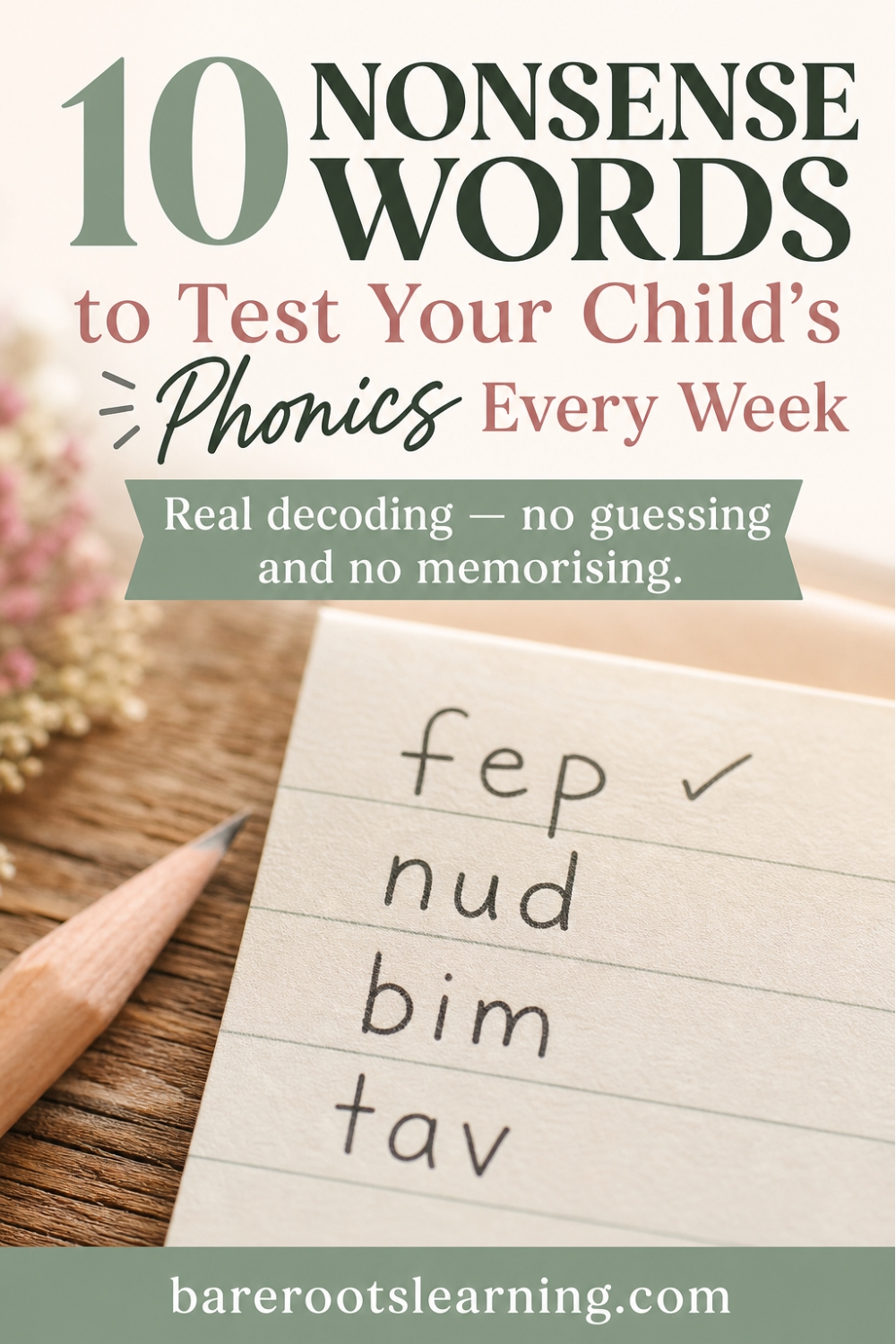
If you want to know whether your child is genuinely decoding – or just recognising words they’ve seen before – nonsense words are your most reliable test.
They can’t be memorised. They can’t be guessed from pictures. The only way to read them is to decode them, sound by sound. Which means if your child can read a nonsense word, they can read anything built from the same phonics patterns.
Here are 10 to use this week, plus how to make this a simple part of your regular routine.
Why Nonsense Words Work
Real words carry a risk of familiarity. A child who has seen “cat” fifty times on flashcards might recognise it on sight – but that doesn’t tell you whether they can decode the pattern /c/ /a/ /t/. They might simply have the shape of the word memorised.
A nonsense word like “fap” or “nid” removes that possibility entirely. There’s no stored memory to fall back on. No picture to look at. No sentence context to guess from. Just the letters, the sounds they represent, and the blend.
A child who reads “fap” correctly is demonstrating genuine phonics knowledge. That’s the real test.
This Week’s 10 Nonsense Words
These are all built from Phase 1 and Phase 2 phonics patterns – basic consonant-vowel-consonant structures with short vowel sounds. They’re appropriate for children working on CVC words and early short vowel decoding.
- fep
- nud
- bim
- tav
- lig
- vut
- kem
- zup
- dav
- hib
How to Use Them
Option 1: Quick daily check. Pick two or three from the list each day. Write them on a small card or piece of paper. Ask your child to read them aloud. No pressure – this is information gathering, not a test with stakes.
Option 2: Real vs nonsense sort. Write five real CVC words and five nonsense words on separate cards and mix them up. Your child reads each card and sorts them into two piles: real words and made-up words. This adds a layer of comprehension check on top of the decoding.
Option 3: Nonsense word swap. Take a nonsense word and ask your child to change one sound to make it a real word. “Fep” – change the first sound – becomes “pep,” “lep,” or “bep” (still nonsense). Change the vowel and “fep” becomes “fap,” “fip,” “fop,” or “fup.” This is excellent for building phoneme manipulation flexibility.
What to Look For
Confident and accurate: Your child is decoding well at this level. Time to introduce more complex patterns – digraphs, short vowel contrasts, or consonant blends.
Slow but accurate: Normal for early decoders. Speed comes with practice and repetition. Keep going.
Guessing real words: A child who reads “fep” as “pet” or “fap” as “fat” is pattern-matching to familiar words rather than decoding. This is a sign to slow down and do more segmenting and blending work before moving on.
Refusing or shutting down: Some children feel exposed by nonsense words precisely because their usual guessing strategies don’t work. Reassure them that made-up words are supposed to be impossible to recognise – that’s the whole point! Their job is just to sound it out.
Make It a Weekly Habit
The most effective use of nonsense words is as a brief weekly check-in rather than an intensive drilling activity. Two minutes, three times a week, tells you more about your child’s decoding progress than most formal assessments.
Keep a simple note – even just a tick or cross next to each word – to track which sounds are solid and which need more work. Over a few weeks, a clear picture of your child’s phonics development will emerge.
Free Diagnostic Download
If you’d like a ready-made phonics diagnostic that includes a nonsense word check alongside a real word assessment and a parent observation guide, the free Bare Roots Learning Homeschool Blending Toolkit has everything you need.
It takes less than five minutes to use and gives you a clear picture of exactly where your child is – and what to focus on next.
[Download the free toolkit by entering your details below →]