

Why Decodable Books Work Better Than Predictable Readers (And What to Use Instead)
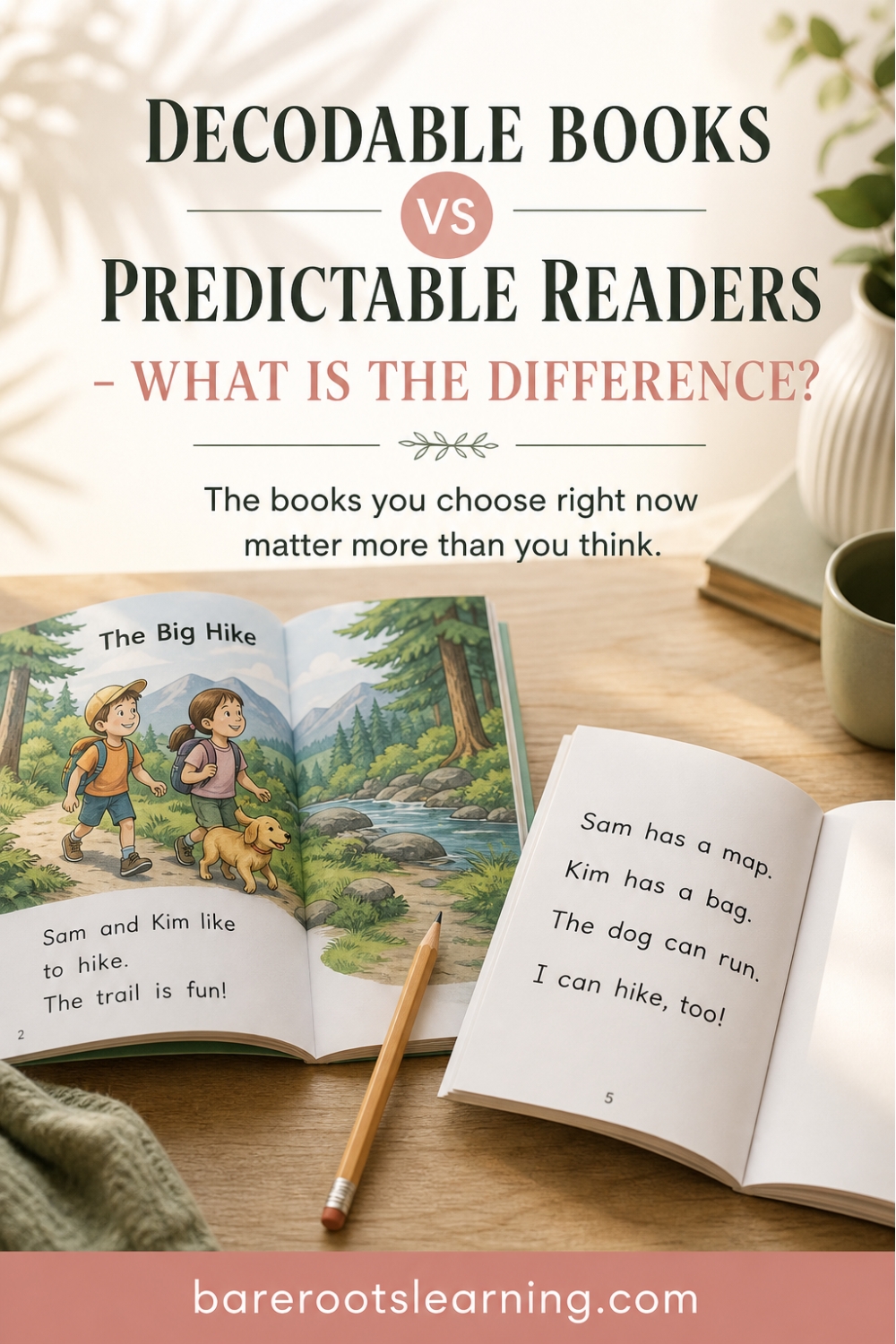
Walk into most early years classrooms and you’ll find shelves of brightly coloured reading books with a pattern you’ll quickly recognise: “I see a cat. I see a dog. I see a bird.” Each page has a big illustration and one sentence that follows the same structure.
These are predictable readers. And while they look like phonics books, they’re teaching something entirely different from what they appear to.
What a Predictable Reader Actually Does
Predictable readers are designed around repetition and picture support. The sentence frame stays the same on every page. The new word – the animal, the colour, the object – is illustrated directly beside it.
A child who “reads” these books is largely looking at the picture, recognising the pattern, and guessing the new word. They don’t need to look at every letter. They don’t need to decode anything. The book is designed so they don’t have to.
This feels like reading success. It often looks like reading success. But the skill being built is pattern recognition and picture guessing – not decoding. And those two things are not the same.
What a Decodable Book Does Instead
A decodable book is engineered differently from the ground up. Every word in the book – or close to it – is built from letter-sound relationships the child has already been explicitly taught.
If a child has learned short vowels and basic consonants, the book contains only words made from those patterns. No sneaked-in silent e words. No vowel teams that haven’t been introduced yet. No reliance on the picture to figure out what the word says.
This means the child has to look at every letter. There’s no shortcut. The picture might show a scene, but it doesn’t give away individual words. To read the book, they have to decode it – and that’s exactly the point.
Why It Matters More Than Most Parents Realise
Eye-tracking research on skilled readers shows something surprising: fluent readers process every single letter in a word almost instantaneously. Reading doesn’t work by recognising the general shape of a word or guessing from the first letter. It works by the brain firing in response to the complete sequence of letters.
The path to that effortless, automatic recognition runs directly through deliberate, effortful decoding practice. Every time a child decodes a new word correctly – actually looking at each letter and mapping it to a sound – that word moves a little further toward automatic recognition.
Predictable books bypass this process entirely. Decodable books force it in a controlled, supportive way. That’s the difference.
What to Look for in a Decodable Book
Not all books marketed as “phonics readers” are genuinely decodable. Here’s a quick check:
Open the book to any page. Look at the words on that page. Are they built from simple, consistent letter-sound patterns? Or do they include complex spellings, sight words introduced without explanation, or words that depend on the picture to identify?
Look at the pictures. Do they illustrate the scene, or do they give away specific words? A picture of a whole playground scene is fine. A picture of a specific rabbit next to the word “rabbit” is not – it’s doing the reading for the child.
Check the scope and sequence. A good decodable series introduces words in a deliberate order – short vowels before long vowels, simple consonants before digraphs – and sticks to that sequence strictly.
A Practical Starting Point
If you’re not sure where to start with decodable books, the simplest approach is to match the book’s phonics level to whatever your child is currently practising. If they’re working on short vowel CVC words, find books that contain only those patterns.
At this stage the books will feel very simple – that’s intentional. The goal isn’t an interesting story. The goal is successful, confident decoding practice. The interesting stories come later, once the decoding is automatic.
Ready to Build a Real Reader?
The free Bare Roots Learning Homeschool Blending Toolkit includes a simple diagnostic page that helps you identify exactly which phonics stage your child is at – so you know which decodable books will be the right match right now.
[Download the free toolkit by entering your details below →]