

b and d Confusion in Kindergarten: A Simple Visual Fix That Actually Works
Sitting at the kitchen table, watching your five-year-old carefully write “ded” instead of “bed” for the fourth time this week can send a sudden spike of anxiety straight to your chest. Is this dyslexia? Are we failing at phonics?
Take a deep breath and take a sip of your tea. Letter reversals in kindergarten are entirely normal. In fact, it means your child’s visual system is working exactly as nature intended! Before you start drilling flashcards or buying expensive apps, let’s look at the fascinating cognitive science behind why this happens – and the simple, screen-free ways we can gently correct it at home.
The Science: Why Your Child’s Brain is Actually “Too Smart”
To understand why ‘b’ and ‘d’ are so frustratingly tricky, we have to look at how the brain actually learns to read. Humans are not born with a pre-programmed “reading centre” in the brain. Instead, as we teach our children phonics, they have to physically recycle a part of their visual system – an area in the left hemisphere called the Visual Word Form Area (VWFA) – to process printed letters.
From birth, your child’s visual system has a built-in survival adaptation called mirror invariance. In plain English, mirror invariance is the brain’s natural ability to recognise an object as the exact same thing no matter which way it faces. A dog is a dog whether it is facing left or right. A chair is a chair whether it is pushed in or pulled out. This is a brilliant evolutionary adaptation for recognising objects in the real world.
The Simple Visual Fix: The “Bed” Trick
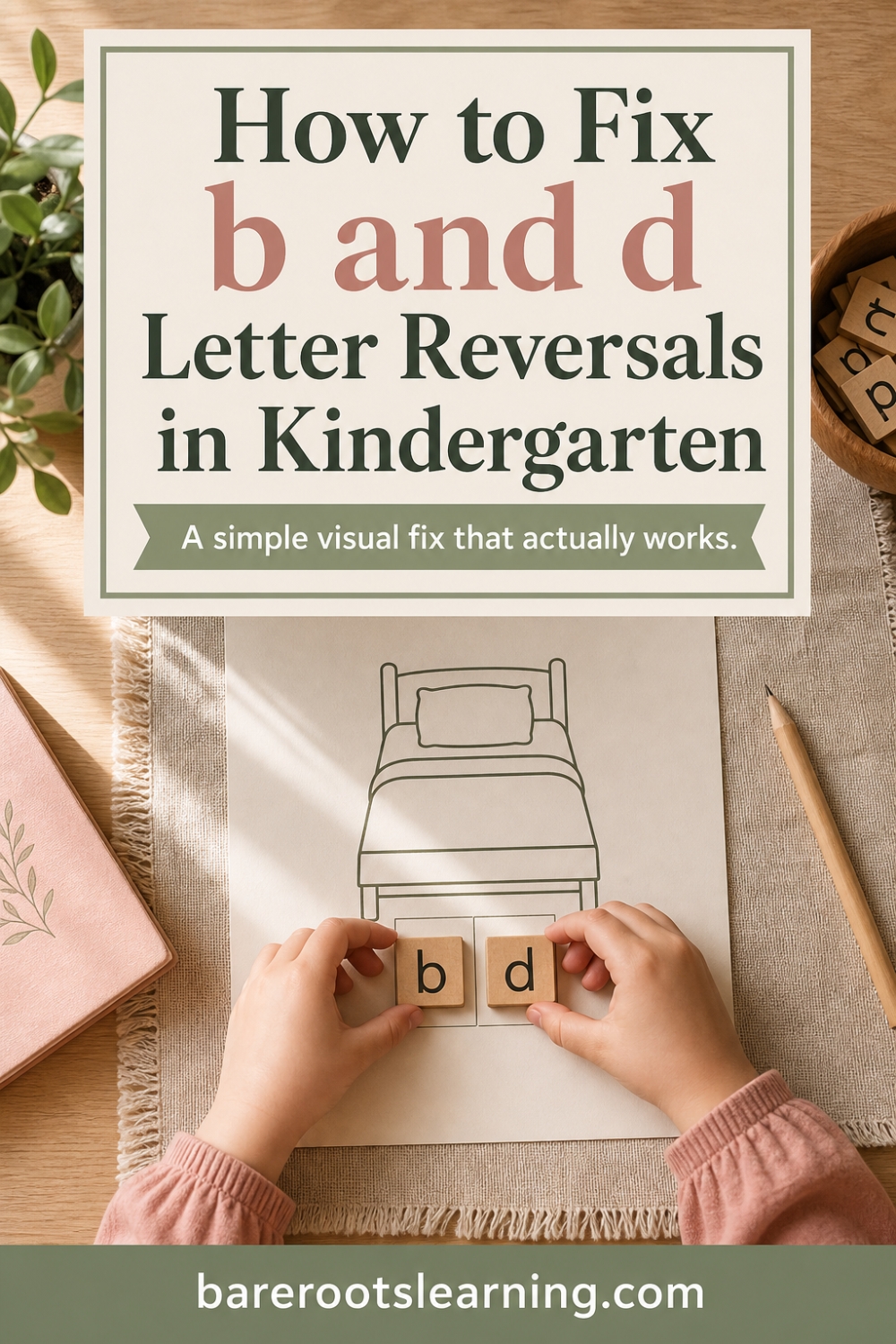
Because our children are tactile, concrete learners at this age, we need to give them a physical, visual anchor to help them remember the direction of these tricky letters. The easiest way to do this is the visual “bed” trick. Draw a simple line drawing of a bed on a clean piece of paper, and have your child place their wooden letter tiles for ‘b’ and ‘d’ next to it.
Show them that the word “bed” actually looks like a physical bed!
- The ‘b’ is the headboard (the tall stick comes first, then the round mattress).
- The ‘d’ is the footboard (the round mattress comes first, then the tall stick).