

Syllable Clapping Activities for Kindergarten: A 5-Minute Daily Routine
You are sitting at the kitchen table, trying to get your five-year-old to focus on a reading lesson. It is perfectly normal to sometimes feel exhausted by the process! Before a child’s eyes are ready to decode printed letters on a page, their ears must first be tuned to the sounds of spoken language.
To build an early reader, we have to develop their phonological awareness – the broader ability to hear sound patterns, which includes syllables, rhyme, and individual sounds. Syllable clapping is a brilliant, science-backed way to introduce this concept, and it requires absolutely no preparation.
Why Clapping Works (The Cognitive Science)
Translating the fluid, continuous stream of spoken language into distinct parts is a highly abstract task for a young brain. Five-to-six-year-old learners have incredibly fragile working memory capacities, and overloading them actively halts learning.
Translating the fluid, continuous stream of spoken language into distinct parts is a highly abstract task for a young brain. Five-to-six-year-old learners have incredibly fragile working memory capacities, and overloading them actively halts learning.
If you ask a child to simply “listen” for the syllables in a word, their working memory can easily become overwhelmed. However, when you pair the auditory task of hearing the word with a physical, tactile-kinesthetic motion – like clapping their hands – you provide vital feedback to their motor cortex. This physical anchor reduces the cognitive strain, turning an invisible sound into a concrete, physical action they can feel.
The 5-Minute “Clap and Count” Routine
Educational research demonstrates that prolonged phonics drills are counterproductive for this age group, quickly leading to cognitive fatigue and frustration. Optimal learning happens in high-frequency micro-bursts.
Educational research demonstrates that prolonged phonics drills are counterproductive for this age group, quickly leading to cognitive fatigue and frustration. Optimal learning happens in high-frequency micro-bursts.
Here is a highly effective, 5-minute syllable routine you can easily implement at your kitchen table today:
1. Say It Aloud Start with highly concrete, familiar words. Say the word clearly and naturally.
2. Clap the Beats Model the activity first. Say the word again and exaggerate the physical motion, clapping once for every syllable or “beat” you hear. Have your child join in and clap alongside you.
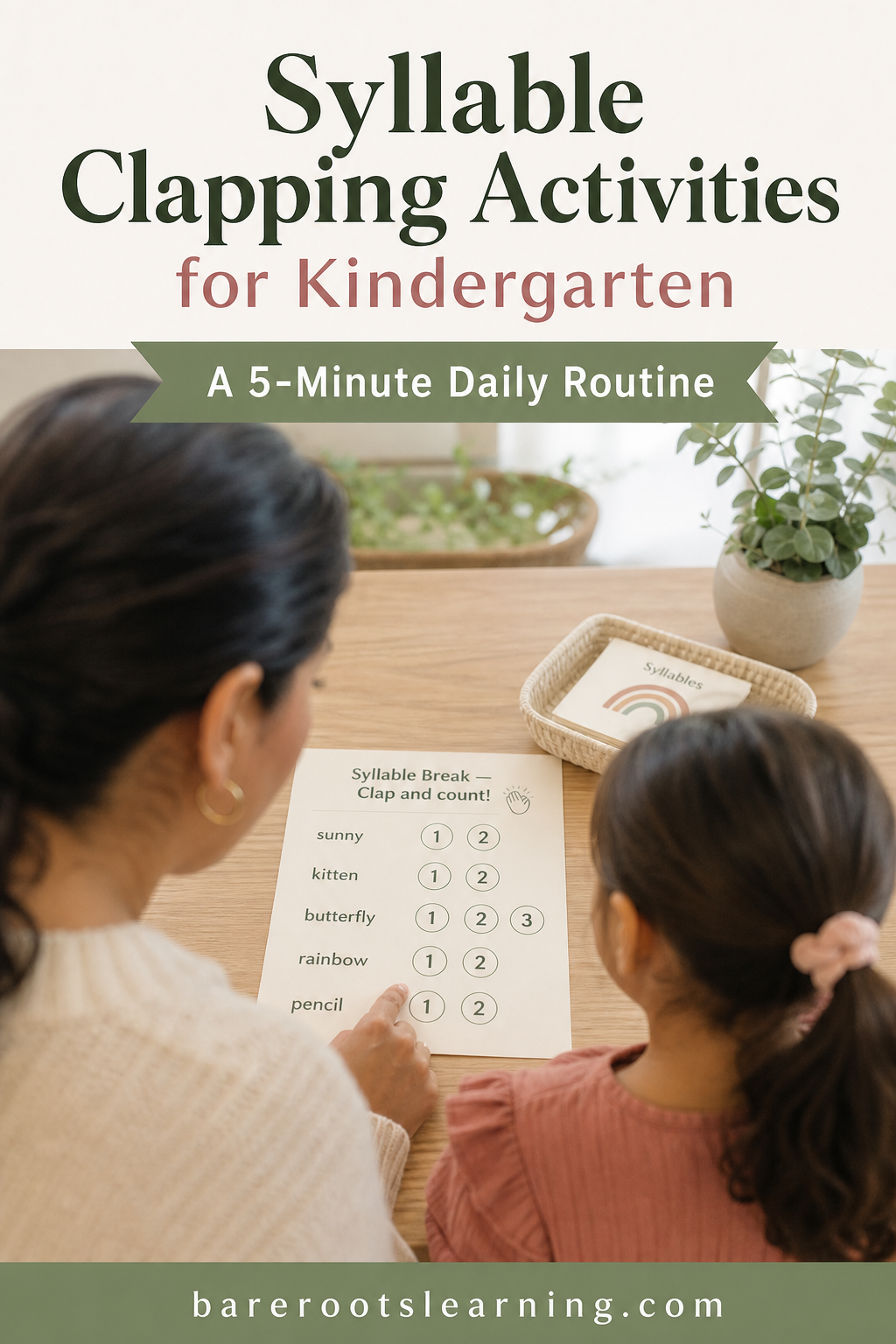
3. Map the Claps on Paper To solidify the learning, transition the physical clapping to a clean, visual format. Using a simple “Syllable Break – Clap and Count” worksheet, have your child independently circle the number of claps they just performed (for example, choosing between 1, 2, 3, or 4). Marking the number down visually acts as a cognitive milestone, bridging the gap between physical movement and printed representation.
Keep this routine fast-paced, joyful, and strictly under 5 minutes. When you protect their attention span, you will be amazed at how quickly their auditory discrimination grows!
Ready to eliminate preparation fatigue?
If you are tired of spending your evenings cutting, sorting, and piecing together confusing activities, let me help. Download the Free Early Phonics Toolkit today. It is packed with beautifully designed, research-backed “open-and-go” printables – including tactile syllable and sound-mapping sheets – to help your child master foundational reading skills with absolutely zero stress. Enter your details below to get immediate access