

A 10-Minute Phonics Practice You Can Do at the Kitchen Table
Are you staring down a heavy, 45-minute reading lesson right now, already dreading the inevitable pushback from your tired five-year-old? When you want your early reader to succeed, it is so easy to fall into the trap of thinking that longer lessons equal better results. But if your daily seatwork is ending in tears, frustration, and cognitive burnout, you are not doing anything wrong.
Educational psychology actually tells us that expecting a five-to-six-year-old to engage in prolonged, continuous phonics drills for 30 to 45 minutes is developmentally inappropriate and actively counterproductive. Prolonged drills induce cognitive fatigue and task-avoidance behaviours, causing a steep decline in memory consolidation.
Instead, cognitive research demonstrates that learning outcomes are optimised when practice is structured in short, high-frequency, “micro-training” bursts of just 10 to 15 minutes. This high-velocity, fast-paced instruction keeps engagement high and prevents visual fatigue.
You can build a confident, fluent reader in just ten minutes a day! Here is a highly effective, science-backed phonics routine you can do at your kitchen table right now using things you already have around the house.
Minute 1 – 3: Physical Sound Mapping
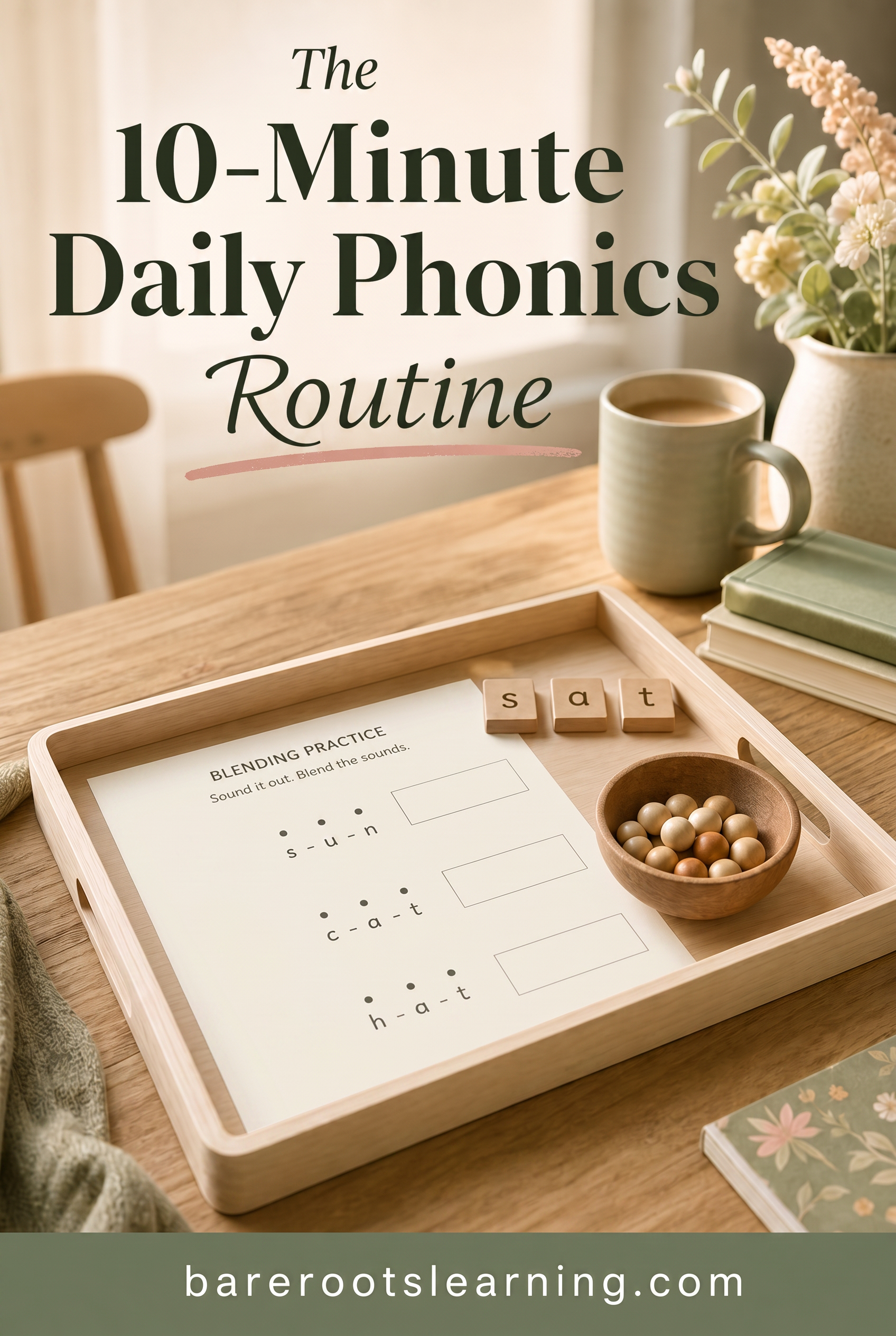
For young children, translating the fluid stream of spoken language into distinct, written letters is incredibly abstract. Before they pick up a pencil, we need to make those invisible sounds physical. Draw three simple squares on a piece of paper (these are called Elkonin boxes). Give your child three small objects – like wooden beads or small balls of play-doh, or even scrunched up pieces of paper. Say a simple consonant-vowel-consonant word like “cat” and have your child touch or push a token into a box for each sound they hear: /c/ – /a/ – /t/. This simple spatial scaffolding drastically reduces their working memory load and helps their brilliant brain internalise the structure of the word.
Minute 4 – 7: Tactile Word Building
Now that their ears are tuned in, let’s connect those sounds to letters. Instead of handing them a busy tracing worksheet, grab a set of physical letter tiles or magnetic letters. Ask your child to build the word they just mapped. Research shows that tactile word building activities – where a child constructs a word phoneme-by-phoneme – significantly outperform standard worksheet drills for reading and spelling. It forces them to look closely at the exact spelling sequence from left to right, building true orthographic mapping rather than just relying on visual memory.
Minute 8 – 10: The “Nonsense Word” Check
Wrap up your kitchen-table session with a quick, two-minute fluency check to make sure they are actually reading and not just guessing. Write down three “real” words they know, mixed with three “nonsense” words (made-up words like fep, bim, or nud). Because a child cannot recognise a nonsense word by sight or guess it from a picture, reading these made-up words forces them to apply pure decoding skills. It is the most honest, effective phonics test there is, and it tells you exactly where their reading circuits are thriving!
Ready to start your 10-minute micro-sessions? If you want to skip the late-night prep and dive straight into high-yield learning, download the Free Homeschool Blending Toolkit today. It is packed with minimalist, science-backed resources – including tactile cut-out letter tiles, a reusable “Read, Map, Write” template to guide your sound mapping, and a 2-Minute Diagnostic Grid featuring nonsense words so you can see exactly where your child is getting stuck. It is a completely open-and-go system designed to build genuine reading confidence tomorrow morning with absolutely zero prep! Enter your details below for immediate access.