

Best Order to Teach Letter Sounds: (What the Research Says)
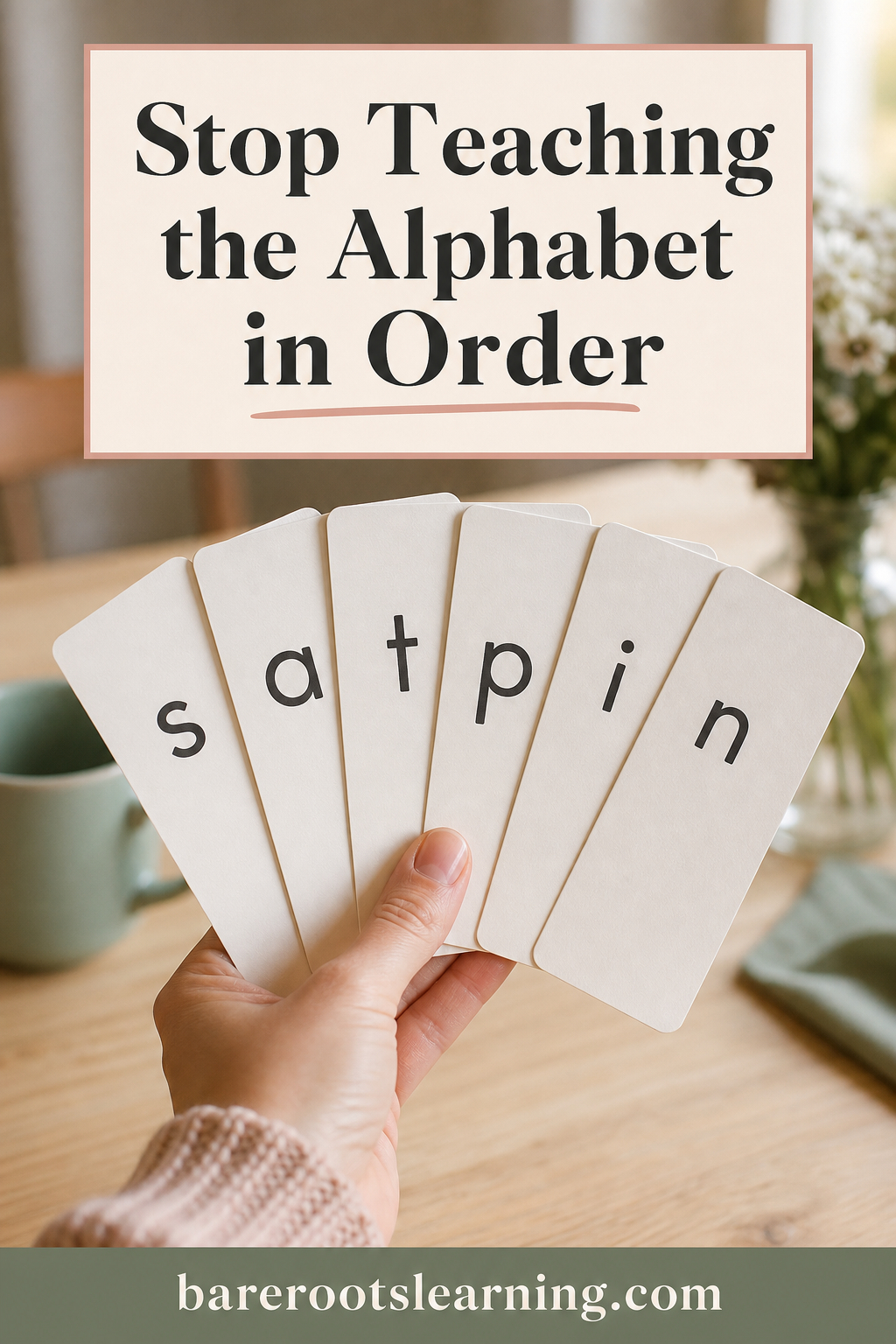
If you are preparing to teach your early reader their letter sounds, you might be staring at an alphabet poster and assuming you should simply start at ‘A’ and work your way through to ‘Z’. It feels like the most logical path! However, if you are looking to build a confident reader without tears or frustration at the kitchen table, cognitive science tells us to throw the alphabet song out the window.
Why Alphabetical Order Delays Reading
Research into early childhood literacy completely rejects alphabetical sequencing. When we teach letters in alphabetical order, children have to learn a massive chunk of the alphabet before they have enough consonants and vowels to actually build a complete word. This delays their “aha!” moment and makes the process feel incredibly abstract.
Instead, empirical evidence demonstrates that letter sounds must be taught in high-utility “functional clusters,” such as the introductory group: s, a, t, p, i, n.
The Magic of High-Utility Clusters By introducing these specific letters first, your five-to-six-year-old can immediately begin blending and segmenting simple, meaningful words like “sat,” “pin,” and “tap” within the very first few weeks of instruction. This immediate application of sounds to whole-word decoding is crucial; it builds genuine early reading confidence and rapidly establishes the alphabetic principle in their brilliant developing brain. To keep engagement high and avoid gaps in motivation, research suggests a brisk, cumulative pace of introducing three to six new letter sounds per week is highly sustainable.
The Short Vowel Trap One of the biggest hurdles for an emergent reader is mastering short vowel sounds. Because they are acoustically and visually incredibly similar, they are a major source of confusion for beginning readers. Specifically, the short /e/ (as in “bed”) and short /i/ (as in “pit”) sounds are the most frequently mixed up.
If you teach vowels in the traditional “a, e, i, o, u” order, you are placing these two highly confusable sounds right next to each other, which actively increases reading and spelling errors as young children struggle to perceive the subtle differences. To protect your child’s confidence, reading researchers strongly recommend separating these tricky vowels by using the non-alphabetical sequence “a, o, i, u, e”. Short “a” is taught first because it is highly distinct and the easiest for a young child to isolate, while the tricky short “e” is purposefully delayed to the very end so the other sounds can firmly consolidate in their memory first.
Moving from Simple to Complex Once your child has mastered these foundational single-letter sounds and short vowels, the curriculum sequence must progress systematically from simple to complex structures. You will want to ensure they are comfortable decoding basic consonant-vowel-consonant words before you introduce consonant digraphs (two letters making one sound, like sh, ch, and th), which should always precede more complex consonant blends (like bl or st).
Ready to start building real decoding skills today? If you want to dive straight into an evidence-based sequence, download the Free Homeschool Blending Toolkit today. It provides a complete, open-and-go system packed with clutter-free resources, including a 2-Minute Diagnostic Grid to spot exactly where your child’s decoding circuits are thriving, tactile cut-out letter tiles, and a reusable “Read, Map, Write” template to permanently anchor new letter sounds. It gives you everything you need to start implementing structured, stress-free phonics straight away!