

How to Teach Irregular Sight Words Without Flashcards
Are you sitting at the kitchen table, holding up a stack of sight word flashcards, feeling your frustration rise as your young reader stares blankly at the word “said”? You practised it ten times yesterday, but today, it is as if they have never seen it before.
If rote memorisation is leaving both of you exhausted, you are not alone. It is incredibly common for early readers to struggle with traditional flashcards. Here is a look at why visually memorising words works against your child’s developing brain, and a simple, screen-free method you can use instead.
The Hidden Trap of Flashcards
Traditional sight word instruction often relies on showing a child a word and expecting them to memorise its overall shape. However, cognitive reading research tells us that treating words as unanalysed visual shapes rather than phonological structures is highly inefficient. When we ask young children to rote-memorise whole words, it quickly overwhelms their fragile working memory and causes cognitive fatigue.
Traditional sight word instruction often relies on showing a child a word and expecting them to memorise its overall shape. However, cognitive reading research tells us that treating words as unanalysed visual shapes rather than phonological structures is highly inefficient. When we ask young children to rote-memorise whole words, it quickly overwhelms their fragile working memory and causes cognitive fatigue.
The “Heart Word” Method: A Simple Fix
Instead of relying on visual memory, we need to help children permanently anchor words in their brains through a process called orthographic mapping. This is the cognitive process by which the brain naturally forms letter-sound connections to bond the spelling, pronunciation, and meaning of a word into long-term memory.
Instead of relying on visual memory, we need to help children permanently anchor words in their brains through a process called orthographic mapping. This is the cognitive process by which the brain naturally forms letter-sound connections to bond the spelling, pronunciation, and meaning of a word into long-term memory.
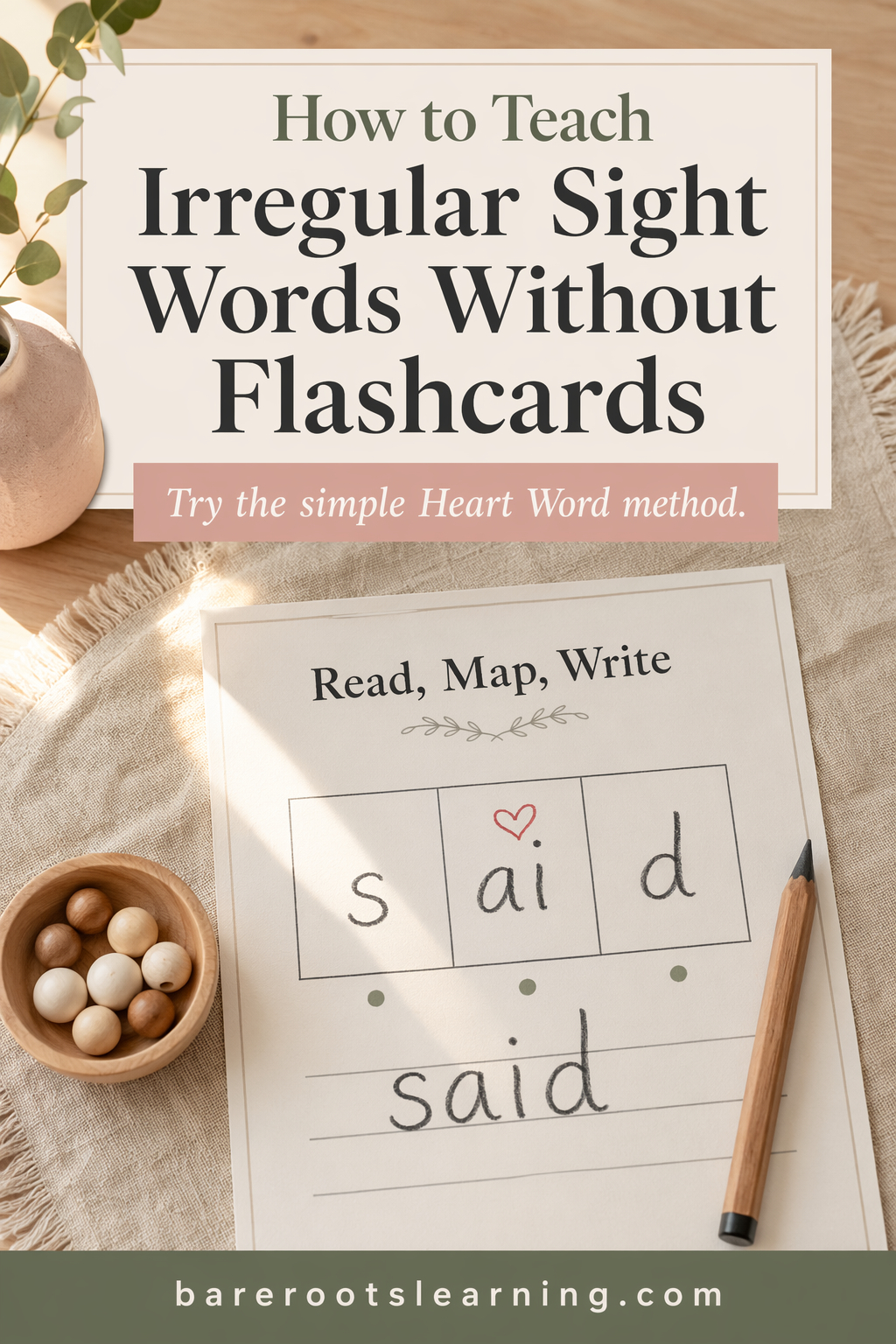
For high-frequency words with irregular spellings, such as “was” or “said,” we use the “Heart Word” method. Instead of pretending the whole word is impossible to sound out, we acknowledge that most of the letters still follow the rules. We simply visually highlight the regular parts of the word and place a specific indicator – like a small drawn heart – over the one irregular letter-sound relationship. This signals to your child that this specific, tricky part is the only piece they need to learn “by heart”.
How to Map a Heart Word Today Here is a fast, tactile routine to try at your table:
- Say It: Say the target word aloud together.
- Map the Sounds: Draw physical boxes for each sound you hear (for example, the word “said” has three speech sounds: /s/ – /e/ – /d/).
- Find the Heart: Have your child write the regular letters in their boxes (the ‘s’ and the ‘d’ for the first and last boxes), and then draw a little heart over the tricky middle box where the letters ‘ai’ make the /e/ sound.
By breaking the word down and finding the “heart” part, you remove the guesswork and give your child a logical, concrete way to master tricky words without the tears!
Ready to ditch the flashcards? If you are tired of rote memorisation leaving you both exhausted, download the Free Homeschool Blending Toolkit today. It is packed with clutter-free, science-backed resources – including a 2-Minute Diagnostic Grid to see exactly where your child is getting stuck, tactile cut-out letter tiles, and a reusable “Read, Map, Write” template to help them permanently anchor tricky words. It is a completely open-and-go system, giving you everything you need to build genuine reading confidence tomorrow morning with absolutely zero prep!