

Rhyming Activities for Preschool That Build Early Reading Skills
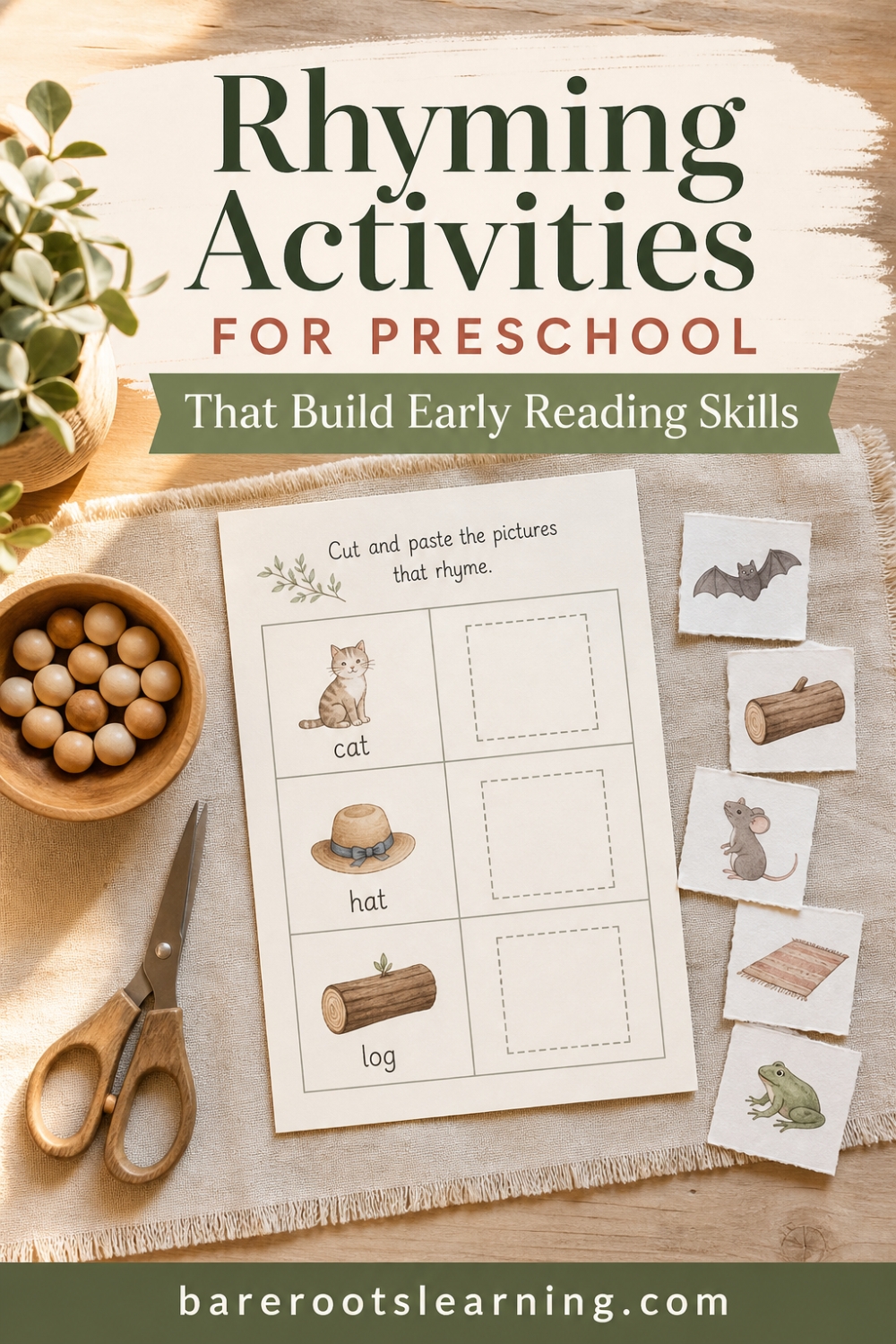
Teaching a four or five-year-old the foundations of reading can sometimes feel like a daunting task. If you have been researching early literacy, you might feel the pressure to start drilling letters and complex phonics rules immediately. But that’s not necessarily the case. Before a child’s eyes are ready to decode letters on a page, their ears need to be properly tuned to the sounds of language.
This is where rhyming comes in. Rhyming isn’t just a playful activity; it is a critical, scientifically backed stepping stone toward true literacy.
The Science Behind the Rhyme
To build a confident reader, we first have to develop their phonological awareness – the broader ability to hear sound patterns – syllables, rhyme, and individual sounds. Reading acquisition relies heavily on this sensitivity to the sound structure of spoken language.
When young children play with word families (groups of words sharing a common rhyming ending, like the “-at” family: cat, bat, hat), they are tapping into the brain’s natural pattern-matching abilities. This allows them to quickly generate a large vocabulary by analogy. However, cognitive science reminds us that we have to be careful not to let rhyming become a mindless, visual drill. If children just stare at neat, rhyming lists, they can blindly repeat the pattern without truly analyzing the individual sounds.
To build genuine phonological awareness, we need to make rhyming active, auditory, and physical. Here are three simple, screen-free rhyming activities you can do at your kitchen table today.
1. The “Cut and Paste” Rhyme Sort
Preschoolers often struggle with abstract auditory concepts, so bringing in a physical, tactile element works wonders to safeguard their attention and reduce working memory load. Using a clean, simple Rhyming Cut and Paste worksheet, have your child cut out word or picture tiles and physically glue them under the correct rhyming ending (such as -ag, -it, or -oat). Engaging these tactile-kinesthetic pathways through physical paper manipulation provides vital feedback to their developing brain and accelerates learning.
2. “Trash or Treasure” Auditory Sorting
This is a brilliant, zero-prep game that builds deep auditory discrimination and forces active listening. Say two words out loud to your child (for example, “bug” and “rug,” or “pen” and “cat”). Ask them to listen closely. If the two words rhyme, they get to place a physical token (like a wooden bead or a button) into a “Treasure” bowl. If the words do not rhyme, the token goes into the “Trash” pile. Because this is an entirely auditory task, it forces their brain to truly listen to the sound patterns rather than relying on visual guessing.
3. The Read-Aloud Pause
Do not underestimate the educational power of simply cuddling up on the couch with a beautiful, language-rich book. When reading a rhyming story, pause right before the final rhyming word on the page and wait. Let your child’s brain anticipate and fill in the missing sound aloud. This engages their oral language comprehension perfectly, allowing them to build a robust linguistic foundation while enjoying a pressure-free learning environment.
Keep It Short and Sweet
Remember, early childhood learners have incredibly fragile working memory capacities. Expecting a young child to sit for a 30-minute reading lesson is developmentally inappropriate and will only lead to cognitive fatigue and frustration. Keep these rhyming activities to micro-bursts of just 5 to 10 minutes. A short, high-energy sorting game is far more effective than a prolonged drill.
Protect your peace, keep it playful, and watch their reading confidence grow!
Ready to make early reading simple? If you are tired of preparation fatigue and want beautifully designed, research-backed tools, download the Free Early Phonics Toolkit today. It is packed with open-and-go printables, including tactile cut-and-paste sorting activities, to help your child master foundational reading skills with absolutely zero stress. Just fill in your details below to get immediate access.