

What Is the Science of Reading (and Why Should Parents Care?)
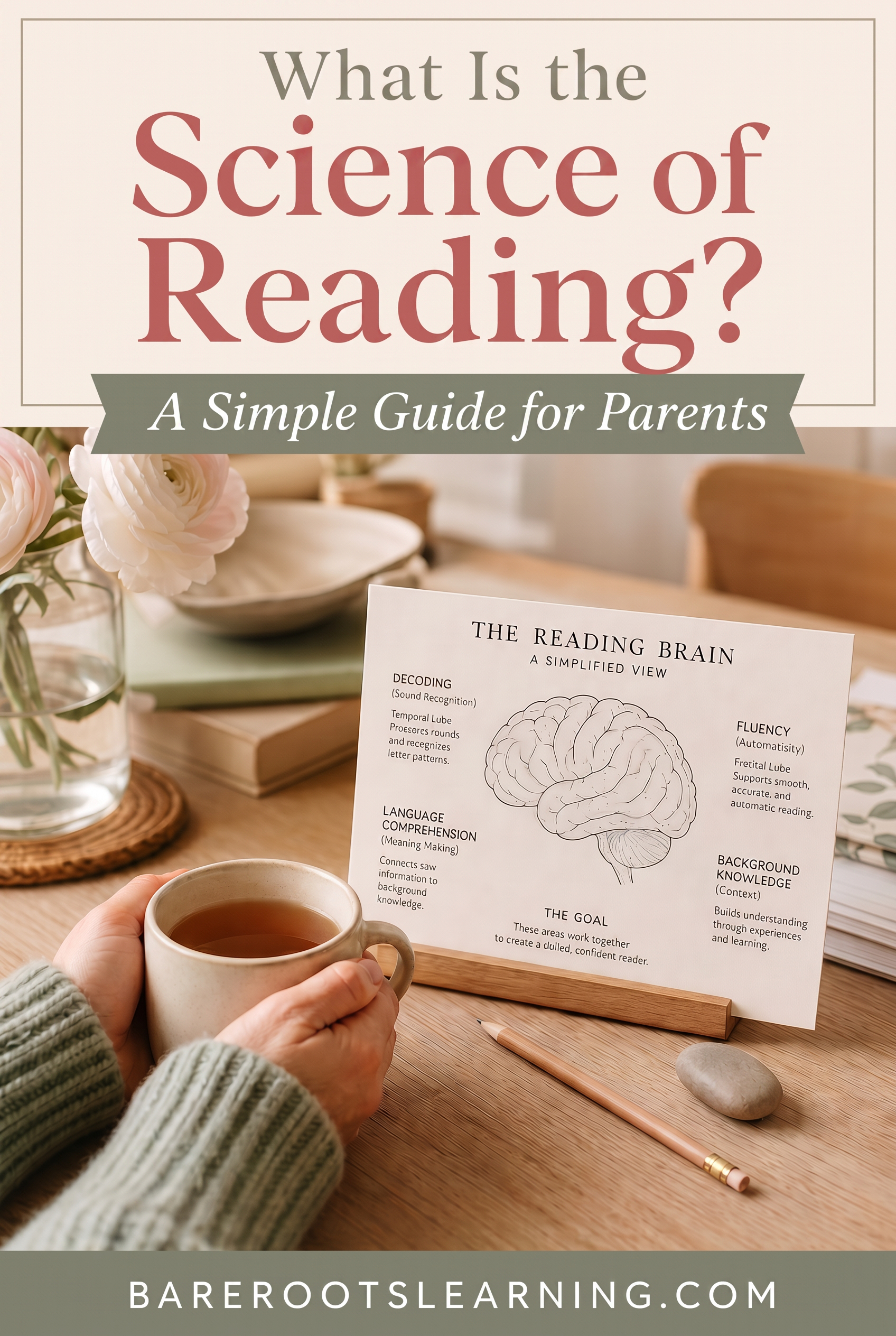
If you have spent any time researching how to teach your child to read, you have likely stumbled across a confusing debate between “balanced literacy” and the “Science of Reading”. Sitting at the kitchen table with an exhausted five-year-old, hearing these academic terms can feel completely overwhelming. But understanding this shift is the secret to protecting your peace and building a confident reader. Here is a simple, jargon-free look at what the Science of Reading actually means for your daily routine.
What Exactly Is It?
The Science of Reading is not a specific curriculum or a trendy new phonics program. It is a comprehensive body of research drawn from cognitive science, psychology, and education that proves exactly how the human brain learns to read. For years, traditional early childhood classrooms relied on “whole language” or “balanced literacy” methods, which often taught children to guess words using context clues, accompanying pictures, or initial letters. The Science of Reading rejects this completely in favor of structured literacy.
The Brain Is Not Wired to Read
Cognitive research reveals a fascinating truth: human beings are not born with a natural brain circuit for reading. While children can pick up spoken language naturally, reading must be explicitly and systematically taught. To read, your child’s brilliant brain actually has to repurpose a visual area – the Visual Word Form Area – to process printed letters. When we expect children to just naturally absorb reading through exposure to predictable books or sight word flashcards, we are asking their brains to do something they simply aren’t wired to do.
The End of the Guessing Game
Have you ever watched your early reader look at a picture of a monkey and guess the word instead of sounding it out? This guessing habit is actively discouraged by the Science of Reading. Eye-tracking studies show that skilled readers do not guess words; they process every single letter almost instantaneously. In contrast, looking away from the text to guess from a picture mimics the habits of struggling readers. The Science of Reading tells us that to build true literacy, we must use structured, explicit phonics to map sounds to letters, reading from left to right without relying on visual clues.
Why It Matters at Your Kitchen Table
The Science of Reading follows a model known as the Simple View of Reading, which shows that reading comprehension is the product of decoding (translating letters to sounds) and language comprehension.
Because your young child’s oral language is far more advanced than their decoding skills, trying to mix the two causes cognitive overload. By separating the tasks – using highly structured, picture-free decodable texts for reading practice, and rich, complex read-alouds for vocabulary – you protect their fragile working memory. It removes the guesswork and transforms tears and frustration into a logical, stress-free progression.
Download the Free Homeschool Blending Toolkit today. It is packed with clutter-free, science-backed resources—including a 2-Minute Diagnostic Grid to see exactly where your child is getting stuck, tactile cut-out letter tiles, and a reusable “Read, Map, Write” template to help them permanently anchor tricky words. It is a completely open-and-go system, giving you everything you need to start implementing the Science of Reading tomorrow morning with absolutely zero prep! Just enter your details below to get immediate access.